Showing posts with label neurology. Show all posts
Saturday, October 13, 2018
My Response to The NY Times Epilepsy Story
So many people sent me the recent — let’s call it crowd-sourcing — article detailing a young girl’s hideous epilepsy story and asking for the public’s help, that I’ve lost count. That we live in a period where literally everything is a reality show makes me ill. Crowd-sourcing medicine? Give me a break. This is my response to the parents via the New York Times and the f’d-up medical business community that pretends to Science:
Don’t cut out your child’s brain until you’ve tried cannabis medicine. “Fixing” your child is the hardest, most fruitless journey you will embark upon. The opposite of that is not acceptance. There is healing in the legion of people who know your suffering. Healing and curing are entirely different things.
Tuesday, August 14, 2018
Tuesday Evening Tiny Little Mother Mind™ Peach Pie and Miscellany
In case you're wondering, Sophie continues to enjoy her new community-based adult day program. Today, she and a group of other clients went to the California Science Center. They rode the train downtown, and evidently Sophie loved the ocean room. Of course.
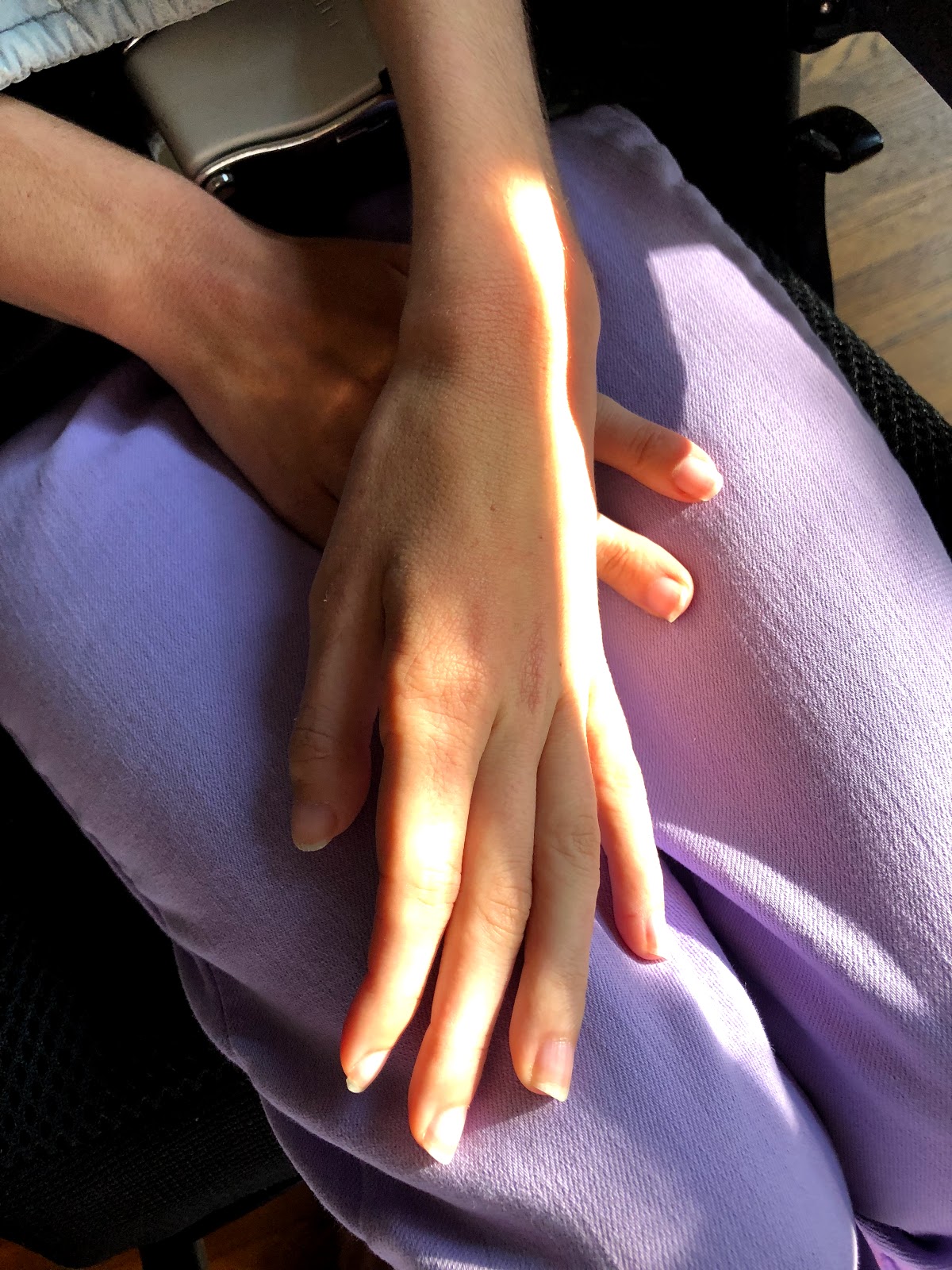
I took this picture this morning. I love Sophie's hands. They are so delicate and fine. I wish that she could use them more.
This sign made me smile and roll my eyes. It's hard to believe what's happened in the last five years in the cannabis medicine world. That being said, I heard about a neurological/pharmaceutical conference recently where the Powers That Be spent a good amount of time denigrating the CBD oils that we've been using for so long. The usual Two-Faced Neuro was there, sort of my nemesis if I really gave a shit anymore, which I don't. He was doing his thing, and this tiny little mother mind™ was doing hers.
Surprise, surprise. I hate to be cynical, but these guy and lady docs are about as cliche as the older man who has an affair with a younger woman.
Recently, a newspaper article touting the benefits of Epidiolex, the new CBD-only single-molecule pharmaceutical approved for Lennox-Gastaut and Dravet Syndrome, quoted a physician who said something to the effect of the "artisan oils" being used were "impossible to test." I don't mince words. What a load of crap. If crap could be, it'd also be transparent -- so clear that Big Pharma and the stooges in the medical world are busy, busy, busy undermining everything that's been done. Telling lies. Propaganda.
Don't get me started.
I made a peach pie today. It's one of the monthly offerings in my gig as baker for Everyone Needs Cake,™ in this case, pie. I took the skins of the peaches, Reader, and honestly? It was like slipping off a silk nightgown.
I tossed them in sugar and whiskey and let them sit for a bit.
I cooked the juices that collected after they sat for a while, added some cornstarch and cooked that up. Then I rolled out the pie dough that I'd made earlier and dumped the peaches in. I made a lattice with the other disc of pie dough and then I froze the whole thing for a couple of hours.
Here's the finished product -- perhaps a tad too brown in places, but my God! Those naked, cooked peaches sure smell good!
Monday, June 25, 2018
The Tiny Little Mother MInd™ and the FDA and Epidiolex
Today, the FDA announced its approval of GW Pharmaceuticals' Epidiolex, a cannabis-based medicine for epilepsy. As I've written countless times here on this blog, I do not begrudge those who want to try this concoction a fair chance to try it. If it works, fantastic. If it doesn't, you know where to go and what to do. What is that? You will probably need to jiggle around your CBD and add THC or one or more of the other cannabinoids. You will embark on a twisty path to healing. I believe this with all of my heart, but it's not a religion. It's fact and science and experience-based.
The reason the tiny little mother mind™ is writing this update is because of the following announcement by the FDA that accompanied their approval:
FDA is deeply concerned about the proliferation of unapproved CBD drug products marketed using unproven medical claims to diagnose, cure, mitigate, treat or prevent serious conditions and we’ll continue to take action against such products.
Cue the revolution. That's right. If the FDA or Big Pharma takes away our freedom to make, use, buy or otherwise give our cannabis medicine to our children or ourselves, there will be a revolution.
Epidiolex will cost between $2,000-$6,000 a month. If you have any experience with manufacturers and insurance companies and how drugs are priced, go figure that shit out. Contemplate that. Read my post from a few weeks ago where I discuss the difference between Epidiolex and the cannabis meds that many of us currently use.
My tiny little mother mind™has said it before over the five years that I and my compadres have been doing this, that there's a swimming pool here and plenty of lanes. Initially, we told the docs and anyone who would listen that they should get on the train because it was leaving the station. We were mocked and humiliated -- literally -- but we didn't give a flying foo and proceeded to save each other's children. We were told that we couldn't discuss cannabis medicine with our neurologists. We were reported to Child's Protective Services. We were obstructed over and over. That did not stop us.
Now, I'm telling you that Big Pharma should use their lane and not infringe on ours or take over the entire pool.
I mean it.
*This has been a Public Service Announcement
Wednesday, May 9, 2018
Witnessing
I took Sophie to her quarterly visit with Nice Neurologist yesterday afternoon. Here's a caregiver tip: take someone with you when you visit a doctor, and you won't be reduced to your usual Psychotic Visiting The Doctor PTSD Self. Saint Mirtha came with me yesterday, and aside from the tremendous help she provides lifting the 4,000 pound wheelchair into and out of the back of my car and ministering to Sophie in the back-seat, her presence just calms me. I felt less chaotic, less alone, less like the person careening into space on my old copy of Sartre's La Nausée. I'm perfectly capable of doing these things by myself and have done so, but it's gotten very, very old in this the two thousandth and eighteenth year of our lord. During the visit with Nice Neurologist, I did my usual and asked him to reverse places so that I was sitting at his desk on the swivel chair and he sat next to Sophie on a folding chair. So I can better explain to you what's going on with Sophie, I said, and use the time to tell you about CBDA, about how I've been weaning the benzo and what dose you'll need to write a prescription for her at this point. Just kidding with the switching chairs. I used to call these visits with All the Neurologists The $475 Reflex Check, but these days I've noticed that All the Neurologists barely touch their patients, much less check their reflexes. Nice Neurologist is so open, though, and he generally has some interesting information about something or other related to immunology or studies being done on mice or genetics -- information that he doles out in a hopeful tone as it might distantly relate to Sophie in between the schooling that I'm doing. He writes down everything I say about CBD and now CBDA, and when I encouraged him to watch Sanjay Gupta's latest show on opioids and cannabis medicine, we had a healthy discussion about the fuckery of the Sackler family and Big Pharma pushing them on the country back in the day. I think I inserted somewhere in this discussion that I'd die happy if The Neurology Community recanted their stance on benzos, particularly with epilepsy patients, and I remember him looking a bit sheepish (was it the eyebrows or the mouth?) and not acknowledging it. He was, in fact, there to write that scrip for the benzo that Sophie's been on for eleven years and not much else. Sigh. Nice Neurologist is awesome, actually, in the long line of Neurologists Sophie and I have encountered during the last twenty-three years. I'm grateful for his attention even as I'm painfully aware that I'm sort of running the show. I made an appointment to bring Sophie back in mid-July and then wheeled her out to the waiting room to join Saint Mirtha who, when we left the office and went down into the parking garage, helped me put Sophie into the car and lift the 4,000 pound wheelchair into the back, even as the four Grown Ass Male Valets stood watching us, gawking. On another day I might have made some caustic remark to one of the men or even shoved them in my mind into one of the luxury cars out-sexing my Sexy Mazda and locked all the doors. Here's a caregiver tip: take someone with you when you visit a doctor, and you won't be reduced to your usual Psychotic Visiting the Doctor PTSD Self. You'll have a witness to all of it.
Sunday, March 18, 2018
Parables of Neurology, The Cosmos
![]() |
| Star Trails Photographer: Carl Jackson |
At some point in the waning years of the last century, Sophie was on her eighth or ninth drug, a drug that wasn't yet FDA-approved but that The Neurologist At The Time thought worth trying. I received the drug from a pharmacy in London, a tiny little shop on a cobblestoned street with a 17th century sign hanging outside that swung in the English rain. You figure out which part of that sentence is fiction. I've told this story before. The drug was a white powder and came in a foil packet called a sachet, and after I carefully poured the contents out, I cut them with a razor blade to get just the right amount for the baby, about enough to fit into a 1/4 teaspoon. I dipped my finger into the powder and put it on my tongue. Powerful enough to stop seizures but bitter enough to spit out. I gave it to the baby.
Know that the word irritable is frequently used in neurology literature as a possible side effect. An Earlier Neurologist listened to my complaints about the Baby's constant fretting and said, You have to figure out what your tolerance is as far as irritability, after which I lit the fuse that connected the telephones of the last century that we were using and blew him up. That should be parenthetical.
On the third day and then night of the drug in the sachet, Sophie began screaming all night long, flailing her arms and arching her back. She screamed until she became hoarse. You can't imagine what a hoarse infant sounds like -- just air but more -- air that you can hear, and I spoke into the air as I walked with her, up and down, up and down. Enough. This is enough. No more. We will not do this. The next morning I called The Neurologist At The Time. The Neurologist At The Time was what they called cutting edge, no pun intended, knives and docs, docs and knives, and I liked him. I was going to say love but that would be fiction. I called him up and said, The Baby is beyond irritable. She is psychotic, if babies can be psychotic. She is still seizing. She is now on two non-FDA-approved drugs and is being weaned from Phenobarbital. How many babies do you know on this combination? Could the three drugs be interacting?
(silence)
The Neurologist At The Time said, That's a very interesting idea, and the words travelled as sound through a wire connecting us, across the country (I was visiting my parents in Atlanta and The Neurologist At The Time lived in New York City) and assembled themselves into block letters that floated out of the can I held up to my ear and spun round my head.
T h a t ' s a v e r y i n t e r e s t i n g i d e a.
(silence)
I have a Bachelor's degree in English and French literature. I've also read an indeterminate number of novels, including all the classics in French. I've studied Mandarin Chinese, excelled in modernist poetry and wrote an honors thesis on Pascal's Pensees. The only science class I took in college was Zoology, and during my senior year I thought I might round out the piles of novels and poetry that lay everywhere in my room by taking Waste Management. I got a D in Calculus. Yet, evidently, as per The Neurologist At The Time, The Cutting-Edge Neurologist, I was having interesting ideas about my nine-month old daughter's brain and its response to seizure drugs from other continents.
I never got over this, by the way.
The landscape changed in a moment, over the telephone. The tiny little mother mind™was born in that moment, and I'd describe the birth as a kind of star trail like the photo the Bird Photographer took in the middle of the California desert, a time-lapse of stars burning or dying or traveling as the world spins on its axis, but that might be a mixed metaphor, and I don't know physics either or even photography. Black holes. No man's land.
This is not fiction.
Stephen Hawking said, The greatest enemy of knowledge is not ignorance, it is the illusion of knowledge.
Tuesday, February 13, 2018
Rhetorical Questions, Part 465,789 with Photos
1. Why is the process of finding, paying for and getting a wheelchair-accessible vehicle so labyrinthine?
or
Why is the process for finding, paying for and getting a wheelchair so labyrinthine?
2. Why does the potential advent of Clobazam Oral Soluble Film not excite me?
or
Why does the potential for an easier delivery of Onfi (that's clobazam) -- likened to a dissolving postage-stamp sized film -- make me die a little inside.
![]() |
| Jimi Hendrix Acid Tabs image found on the interwebs |
(HINT: It's not because of Jimi Hendrix or LSD)
These are rhetorical questions.
3. Why are we able to launch a rocket into space with a luxury car inside of it?
or
Why does this make me feel weary?
![]() |
| Elon Musk's recent venture |
4. Why do we still have to pierce the skin with a primitive needle to get to a vein yet are able to inject a nuclear substance into that vein which will then carry it to the brain where it will light up metabolic pathways and provide information?
![]() |
| Vintage photo of brain imaging equipment |
5. Why did Sophie's most recent bout of seizures stop when I gave her a double dose of cannabis medicine, yet the Powers That Be maintain it has no medicinal benefit?
These are rhetorical questions.
Tiny little mother minds™ ask none but those.
Monday, October 30, 2017
Magnetic Resonance Imaging
It looked like a flower a jewel a prism a kaleidoscope of pink and red and green a mustard yellow. So beautiful it brought tears to my eyes. This part here, The Neurologist said, should be like a bush and it's more like a fern. The language of plants. I stood behind him, peering over his shoulder. My daughter's brain a bloom on a screen, his finger (or was it a pen) brushing along its tendrils, a fern not a bush. Space, too. Too much space there and there. How do I write this or do I not write this? Of course I will write this, me with the words, the ease of them. Call a flower tree and a tree flower (so I thought, lying on my back in the green grass of childhood) and what if we were just God's dream (God, not god, back then) and this, that, was a sort of dream. Calling a brain bush and bush fern. Standing there looking over his shoulder, my daughter's brain a bloom on the screen. The word atrophy. The feathering of a fern where there should be bush. The word cerebellum. I felt sick to my stomach for a moment, standing there, the dots in front of my eyes. Or was it faint? I need to sit down, I said, stumbled around the wheelchair and sat on the couch. I closed my eyes when he spun around on his chair. He's a nice man, a smart man, an honest man. Interesting that it was the tears that flustered him, not the brain a bloom on a screen. That's the way they are. I closed my eyes, heard him rummaging and then leave the room. Back in, he handed me a stack of paper towels, the brown rough ones from the bathroom. I thought that was funny. I really did. I thought it was funny. I'll write it all down, I thought, and then out. I'll build some kind of tension here on the page to mimic that in the room in the brain a bloom on the screen. Atrophy of the cerebellum. We'll need to compare it to an earlier scan (that I'll have to find, to root out from the bowels of some other hospital). The language of medicine mixed up with the language of business the language of poetry. And I a master of all of it nodding my head words blooms from my mouth. On the written report: indicative of epilepsy treatment. I always knew it. The word treatment. Just to be clear: Sophie's recent magnetic resonance imaging showed a couple of troublesome spots, including atrophy of the cerebellum. This could account for her gradual decline in motor abilities (walking, coordinating movement, balance, swallowing). The cause is uncertain -- too many drugs? long-term use of benzodiazepines? underlying metabolic disorder? genetic mutation? -- as always.
How do I write what comes next? I still have some tricks up my sleeve, The Neurologist said, and I laughed. I really did. I thought it was funny. Should they use phrases like this? Me with the chalked hands and the pirouette toes up on the high wire for decades. You as spectator your breath held.
Bloom, brain.
Wednesday, October 18, 2017
The United States Medical System, Part One in a Series Through Photos
Sunday, July 30, 2017
Cannabis and Pediatric Neurology: A Modern Day Fairy Tale with a Villain
![]() |
| Sophie and Me La Jolla, CA 1999 |
Sophie was about four years old in that picture. I was 35, and it was the turn of the century and the millennium.
Once upon a time.
I sure wish that I could have had access to CBD oil back then.
I might have avoided nearly twenty years of frustration in controlling Sophie's seizures. She might have never become addicted to the benzo. We might not have had to try fifteen more drugs (she'd already been on eight in this picture). We might have avoided the second trial of the ketogenic diet which reduced Sophie to a pacing tiger in a cage waiting for her slice of strawberry embedded in a stick of butter, her stool impacted and no seizure relief, myself a fucked-up wreck of a woman. We might have avoided a broken leg, a broken nose, a broken hand, a split-open forehead and back of head, more than twenty stitches, permanent teeth knocked out, and a host of side effects: screaming, rigidity, sleeplessness, catatonia, anorexia, stomach pain, headache, fevers, rashes, hives, irritability, ataxia, dizziness, muscle weakness, blurry vision and cognitive decline.
Tonight I learned that another family has been threatened by a pediatric neurologist at UCLA. I'm not going to use his name, but I've written about him on this blog. I've also written quite recently about my own encounter with a bully -- Sophie's adult neurologist and her superiors who refused to discuss medical cannabis with us, even after we had been doing so for nearly five years. The irony of the recent scandal going on in the USC medical school is not lost on me. Look it up if you want to hear some serious shit.
But I digress.
This UCLA pediatric neurologist's "area of expertise" is infantile spasms, the disorder that Sophie was diagnosed with in 1995. I will remind you that the treatment protocol for infantile spasms is nearly identical to the one we used twenty-two years ago with the exception of a "new" drug that is not new. It was approved by the FDA years after we used it. We tried it back in the last century at the urging of our very cutting edge neurologist because Sophie had already failed eight or so drugs in various combinations. She was nine months old. We got it from England, and we gave it to Sophie along with two other drugs. It didn't work and caused what I thought was psychotic behavior in a baby. Screaming for most of the day and night. It had not been tested, you see, on babies, and who knew whether that particular cocktail of drugs was causing more harm?
This drug Vigabatrin went off the market for a time because it can, in rare instances, cause serious irreversible vision damage. When your doctor prescribes it for your child's infantile spasms or seizures, you have to sign a waiver that you know about this risk. The other standard treatment for infantile spasms is ACTH, a high dosage steroid, administered by intramuscular injection. I believe brain surgery as a treatment has advanced somewhat, but -- it's brain surgery, and you have to be a candidate for it. You have to have a focus area to mess with in the operating room. Sophie did not have a focus.
90% of babies diagnosed with infantile spasms will have moderate to severe cognitive disability and refractory seizures. This number has not improved in decades despite "advancements."
This pediatric neurologist at UCLA is one of the several neurologists in the city, in the country, who are involved in GW Pharmaceuticals' studies of cannabis medicine and their cannabis product Epidiolex.
This pediatric neurologist openly tells his patients about CBD oil and tells those of us in the "veterans" community that he supports its use, but then he threatens families with Child Protective Services.
He is a Janus-like figure, or perhaps that is too kind.
He is two-faced.
We can only surmise that he and others like him want people to stop using what Big Pharma calls "artisanal oils" and start using Epidiolex. We can only surmise that they are -- let's say -- "on the dole" with GW Pharmaceuticals.
Follow the money, as they say. Except that these are not crumbs laid to remember your way to safety.
I will say that he is a bully. I will say that there a lot of bullies in the neurology world -- both pediatric and adult. I understand that there is a lot of fear. There is liability, lawyers, corporate policy. Medicine As Business.
I will say that we do not trust these neurologists.
I will say that there are pediatric and adult neurologists who are not bullies and who are willing to work with parent experts in a manner that is family-centered. I encourage you to leave your pediatric neurologist or adult neurologist if you are being bullied. I encourage you to advocate for full and open communication with your physicians and demand that they do the same. If they can't work with you, and you are using cannabis medicine, then they should tell you so directly and give you the choice to leave and find another neurologist. I realize that this might be impossible, so do what you need to do. You are in charge.
I don't know if there's a happy ending to this story, or if there's an ending at all. It seems, sometimes, as if we are always beginning.
Feel free to share this post with anyone that might find it helpful. I'm sorry that it pertains primarily to legal states and particularly California, but as long as we have docs averse to communication, we're going to see similar crap going down all over the country as the laws are eased.
Here are your rights and some resources:
Where to Find Pediatric Cannabis Support
Is Medical Marijuana Legal for Children in California
Patients' Guide to Medical Marijuana Law in California
Wednesday, July 12, 2017
An Open Letter to The Neurologist and Those Like Her
The following is the text of a letter I wrote to the neurologist who used to "take care" of Sophie. I wrote the letter in response to that doctor's refusal to consult with Sophie's cannabis doctor about her care, even as we sat in a hospital room trying to figure out what was wrong with Sophie. I have since found another neurologist who is willing to work with Sophie's cannabis medicine and communicate accordingly. That's a good thing. After vetting the letter with a few trusted friends , I sent it to several people, all of them connected to The Neurologist and the medical department at the major hospital where she works. I know it's long and perhaps winded, but I was determined to be myself and to convey not only my frustration and anguish but also my anger. I don't care about being concise, nor about burning bridges. In this screwed up time, I am interested in personal honesty, in truth. The letter conveys truth. I've gotten one response so far, and it was a form letter from the Risk Management Department. Of course. I did speak with the person who sent the letter, and he was cordial and sympathetic. He said that he would reach out to the director of the department to personally respond to me, but he wasn't certain it would happen. I told him I had no expectations that it would happen but that I appreciated his efforts. I told him that I had no interest in pursuing this, that I wasn't going to sue or make a stink in any way but through what I do for a living, which is write.
Enough is enough.
Dear The Neurologist:
I’ve sat on and with the words I will write to you today
since the last time we spoke on May 9th. I’ve been mulling over the
proper tone to use as my initial feelings were ones of anger and dismay, and as
a writer and the mother of a child with severe disabilities, I know the value
of thinking before speaking or acting. I had no intention of “burning bridges,”
because I have deeply appreciated and respected your professional opinion and
care of my daughter, Sophie, for more than four years. That being
said, given what transpired between us that day and in the days that followed
when I attempted to better understand our conversation through your colleague [blankety blank], I am still angry and dismayed at your lack of empathy and
professionalism regarding Sophie’s care.
As you might recall, Sophie was admitted to [Blankety Blank] Medical
Center one evening via ambulance because I felt her breathing wasn’t normal
after a couple of seizures. That was the
only hospital that would admit fire department/emergencies and the closest to
our home, so I agree to go there as opposed to [Blank] or even [Blank].
While Sophie has been on Onfi for over eight years of her
life (and three other benzos previously in her 22 years struggling with
epilepsy), she has never had aspiration pneumonia or struggled with increased
secretions. In fact, I was slowly weaning her from the Onfi and was accustomed
to the increased drooling and secretions as part of the weaning/withdrawal
process. In any case, something was not right, so, literally, for the first
time in her life, I called an ambulance, believing that perhaps Sophie WAS very
ill. You have previously expressed concern over Onfi and its risks, including
aspiration pneumonia, so I was cognizant of that, and the EMT found her oxygen
saturation low enough to warrant a breathing treatment in the ambulance. When
we arrived at the hospital, the initial assessment showed slight wheezing but
no other symptoms, and blood work, as well as a normal lung scan showed nothing
out of the ordinary, other than a slightly elevated white blood cell count.
Nevertheless, the doctor in the ER, in consult with you, convinced me to put
Sophie on a course of heavy antibiotics, while a proper culture grew, and admit
her to the hospital. They also gave her another breathing treatment which
seemed to help with the wheezing. I suppressed my own instincts (that Sophie
did NOT have an infection and was, rather, undergoing symptoms of withdrawal
from Onfi) because I was afraid that they might be wrong, and I understood just
how dangerous aspiration pneumonia could be.
That night I spoke at length with Dr. Bonni Goldstein, M.D.
who, as you know, is Sophie’s doctor who advises us on all things
cannabis-related. Her expertise is cannabis, and it was her feeling that
Sophie’s struggles had everything to do with the interactions between Onfi and CBD/THC.
As a pioneer of cannabis medicine as a treatment for seizures, I am used to the
tinkering and adjusting of dosages and strains of medicine to optimize the
effects on Sophie and her seizures. As you know, after nineteen years and 22
AEDs, Sophie’s seizures dramatically lessened when we added CBD oil in December
of 2013. Since that time, she has had 90% fewer seizures overall, and been
weaned from Vimpat and more than half of the Onfi that she was on. Her overall
quality of life – and our family’s – improved dramatically as well.
But back to Dr. Goldstein and our conversation late the
night of Sophie’s admittance to the hospital – I was worried and in anguish
over what to do about Sophie and just did not feel right having her treated for
aspiration pneumonia or infection. Dr. Goldstein assured me that it was a
reasonable protocol, but she also shared some interesting information about
Onfi and CBD. I was overwhelmed and asked her whether she’d consider consulting
with you about the care of Sophie going forward. She agreed.
My feeling was that you are both Sophie’s doctors with two
separate fields of expertise and that perhaps by putting your heads together
with one another and me, we could as a team figure out a plan moving forward on
how to help Sophie.
The next day, I did speak with you from the hospital. You
blew off my objections to Sophie having an infection and insisted that she did.
Then, when I asked whether you would have a conversation with Dr. Goldstein
about Sophie’s cannabis, you said – and I quote you exactly: “No. I can’t talk to Dr. Goldstein. I’m sorry, but I have
direct orders from my boss NOT to discuss cannabis with my patients.”
I’m going to be blunt and say to you that in the heat of the
moment, sitting in a hospital with my daughter, scared and confused, I was
floored. Shocked, really. It was as if I was talking to a stranger and not the
doctor with whom I thought I’d developed a decent relationship for nearly five
years. You said, “I have direct orders from my boss NOT to discuss cannabis
with my patients.”
I’ve been doing this for a long time and am perfectly aware
of the politics around cannabis and epilepsy. I’m familiar with the parlance
and lingo of the neurology community – the “party lines,” the condescension and
dismissal. I’ve participated on panels where I’ve been shut out and down by
physicians, and I admit to not having a particularly high regard for doctors
who don’t think out of the proverbial boxes. I’ve worked as a parent expert with
the National Institute for Children’s Health Quality on epilepsy collaboratives
to improve the lives of children with epilepsy, and I’ve served on several
boards, including the Epilepsy Foundation of Los Angeles. I was a founder of
People Against Childhood Epilepsy (PACE) and helped to raise hundreds of
thousands of dollars for epilepsy cures and treatments before the non-profit
was folded into CURE. I have been a grant reviewer for the Department of
Maternal Child and Health, participating on countless panels in review of federal
epilepsy proposals. I have devoted much of my writing life to advocating for
the disabled and trying to make sense of the medical world and our experience
with it. Most of all, I have experienced twenty-two years of refractory
epilepsy in raising my daughter Sophie. There has not been a single instance
where a drug or treatment recommended by a neurologist in over two decades has
really helped my daughter.
I have tolerated your relative lack of interest in the
success we’ve seen using cannabis medicine because you have always been so open
in the quarterly appointments we have with you. I know that it’s an enormously
controversial and complex subject with many interested parties. I have never
concealed anything from you – including my personal difficulties as a mother
and caregiver. I was grateful to have a caring neurologist in you.
“I have direct orders from my boss NOT to discuss cannabis
with my patients.”
I’ll skip forward a week or so after the hospital admittance.
I left the hospital on the third day because no doctor visited our room and
gave me no indication why Sophie was still on antibiotics. Her lungs were
clear, as was her bloodwork, as was the culture. In short, Sophie did NOT have
an infection and never had an infection. I followed up the hospital visit with
our pediatrician, who ran viral cultures and did another
examination. Everything was negative. We mothers know these things, in the end.
But that isn’t the story here, and, again, I respected your belief in
aspiration pneumonia and wanted to do the right thing.
“I have direct orders from my boss NOT to discuss cannabis
with my patients.”
I called your office and expressed my incredulity at what
had transpired between us. I asked your nurse to provide me with a written policy
that you were not allowed to speak to your patients about medical cannabis. I
have heard stories of doctors calling CPS on their patients, of doctors who
openly refuse to talk about cannabis or who are literally quite ignorant about
it, but I had not experienced that from you in the nearly five years you were
Sophie’s doctor. It seemed outrageous and harmful. It seemed suspicious.
I got a call from your colleague Blankety Blank who
initially gave me what I might call the usual “song and dance” routine about
medical marijuana – the party lines, the “need for more research,” etc. etc. Unfamiliar
with me or with Sophie, she thought I was asking you to dispense cannabis, so I
had to clarify things. When I cut to the chase and asked her for that policy,
she said that she would speak with you and get back to me. She got back to me,
two days later, and told me that you did not WANT to speak to me about cannabis
medicine, but that there was no directive from a “boss” or actual policy that
prevented you from discussing cannabis with your patients.
Basically, Dr. , I’d like to think that there was a
misunderstanding between us, but I can only surmise that you lied to me. I know
that as a physician you are taught to do no harm, but you did harm by lying to
me. You broke a sacred relationship and destroyed the trust I have in you.
Whatever your motivations, and I suspect they are complex, your words conveyed
fear and ignorance, and I don’t want anyone treating my daughter who doesn’t
have the guts to be honest and discuss her feelings openly. I regret having to
change neurologists as I have always had long relationships with each of the
men and women who’ve treated Sophie for more than two decades, but I’ve found
someone who is willing to work with us and discuss cannabis medicine as part of
Sophie’s treatment. Sophie will be seeing him, moving forward.
Despite decades of working to improve it, I am resigned to
the continual problem that the traditional neurology world has communicating
with their patients. I have lowered my expectations, particularly in regard to
cannabis. I admit that the last shreds of my tolerance for the epilepsy world’s
authority in treating refractory epilepsy are gone.
Here’s how Sophie is right now: great. She goes two weeks
without a seizure and had only a couple during the month of June. I’m
continuing to wean her from the Onfi, albeit much, much slower than recommended
as she is so sensitive. I have doubled her dose of cannabis oil and switched
products. We have found that this kind of “shake-up” can work. It is my belief
that Sophie suffers from Benzo Withdrawal Syndrome. I am aware that we might
never be able to wean her completely from that vicious drug, but thank goodness
we have cannabis oil to help.
I am sorry that you and your colleagues have not expressed
any interest in studying Sophie, a human being who developed infantile spasms
at three months of age, who was subjected to twenty-two drugs over nearly two
decades and two trials of the ketogenic diet before finally finding some
modicum of seizure freedom and relief with cannabis oil.
Yes, she is Anecdote, but such Anecdote! You were in the
position to really learn something, and you didn’t care to do so.
I’d caution you and your colleagues to be aware that young
families and individuals trust you and are willing to be open about what they
are doing for their children and themselves. I’d caution you that they will do
whatever it takes to help their children and themselves, and that if you as a
group refuse to work with them, they will hide what they are doing from you.
There will be no partnership or open communication, and that can never be good
for children or the doctor/patient relationship.
I’m a veteran in this horrible world of seizures that don’t
end, of drugs that don’t work, of side effects worse than seizures, of poor
bedside manner, of suspicions and mistrust of pharmaceutical companies and the
doctors that peddle their products and are compensated to do so, of
excruciating withdrawal symptoms from these drugs, of fractured families and
incredible financial strains. Equal to the seizures and the disability that my
daughter has suffered, is the stress of constantly wrangling with the systems
of care, and I’d urge you to imagine what it’d be like if one of your own
children developed the kind of seizure disorder that Sophie has struggled with
for her entire life.
I like to imagine that you’d do the exact same thing as I
have done.
I like to imagine that you, too, would not stay with a
physician who lies to you about your child’s treatment, who refuses to learn
about something that she knows little about, who responds to pressure from
those “above” her (and I am imagining here that there is much pressure above
you about this subject) in the manner that you responded to me.
Respectfully,
-->
Elizabeth Aquino
Subscribe to:
Posts (Atom)