Showing posts with label epilepsy. Show all posts
Saturday, July 6, 2019
A Whole Lot of Shakin' Going On
Reader, we are fine so far after two of the biggest earthquakes we've felt in the twenty years I've lived here. Last night I went outside a bit after dinner and stood in the front yard looking up at the sky. It was a beautiful night, a typical glorious southern California clearness to the air and the temperature, and I noted how quiet it was -- no sirens, no voices, no birds. No birds.
I do not like earthquakes. I do not find them exciting, particularly when they happen really close to one another. I do find them similar, in some ways, to living with a person who has uncontrolled seizures. That means that I never get used to them. They come out of nowhere, cause the same burst of cortisol (or is it adrenaline), and one makes you feel nauseous and like you can't trust the ground under your feet while the other makes you feel nauseous and like you can't trust -- well -- anything. So, I generally practice being mindful, or at least try to be mindful even as I dissociate a bit during Sophie's seizures and marvel/wonder/holy shit! during earthquakes. But we're fine, honestly -- taking stock of emergency supplies, wondering if the 30 gallon container of water in the backyard shed is still good and whether I should go ahead and pack a "to go" bag specifically for Sophie and her meds.
Those meds control Sophie's seizures about as well as preparing for an earthquake controls my nerves. We could stretch out that metaphor to say that all is vanity and there's nothing new under the sun.
I read something the other day about the importance of a belief system -- higher power, etc. etc. to allay anxiety. I remember feeling somewhat faithful in my Catholic childhood and early adulthood, was obsessed, briefly, with the lives of the saints and even went to a Billy Graham revival with my Bible beater college friends, but when I look back and read back (lots of religious agonizing in the journals), from this vantage point of general/relative unbelief in any higher power other than the universe itself and, of course, love, love love, I'm struck by how I labored to believe and how the whole religious thing banks on the myth that it takes labor to believe, to love, to have faith, etc.
which
leads
me
to those I've engaged with over the last few days who argue semantics (the term concentration camp) and wave their silly flags and insist on the rule of law and God and Jesus and prayers and then exclaim should we just let them WALK over the border, then? and bite into their charbroiled burgers and slide some mustard over their hotdogs and watch some hulked up millionaire swing a bat at a ball as American as pie.
Speaking of pie, The Gig Economy Worker made seven peach pies this week and is taking orders for the rest of the summer.
(I picked those donut peaches from a friend's tree, a tree that had a ridiculous number of peaches and bowed branches, so heavy was its fruit. Alas, the taste was not as sweet and generous as the number, so I used very ripe, very delicious peaches from Trader Joe's)
Monday, May 27, 2019
Pick Your Poison
This might be a record for my not blogging -- more than a week since I've bloviated about the various goings-on in my life and not for lack of them. Perhaps I don't feel like talking anymore about how Sophie has been struggling, how the CBD and the benzo and the sleep aid don't seem to be doing the trick, how I don't know really know what the trick is, anyway, but what I do know is that how many seizures is a relative thing, the counting of them, that is. A relative thing. Not something related to something else but rather relative in comparison. I scroll through my social media and between the kids dying (yes, dying) and the regular shit that is Terrible America, Sophie's three to five seizures (big ones) a day (yes, everyday) don't seem too bad. They're everyday or every day. If someone (Sophie) has anywhere from three to five seizures (big ones) a day, is anything working at all? Anyway? I have a friend who keeps meticulous counts of her son's seizures and is able to track, exactly, what affects them. He had seven in February, she might note, and after we increased his CBDa, only three in March. She agonizes over three, I think three! (Imagine three!) And I continue to draw up the syringes of benzo, syringes of CBD oil and CBDa oil (plunged into her mouth) capsules of sleep aid that I toss in there (her mouth) and the cup, quick, to her lips.
Swallow.
So. The Nice Neurologist suggested we try either Depakote or Lamictal. They're very good drugs, he said. Has she been on them? He asked. I said, Oh, yes. She's been on both. The Depakote in 1995, when she was six months old, diagnosed for three months, drug number three. And it didn't work, so we took it right off and tried the infantile ketogenic diet next (plucked smack dab out of People Magazine, check it out), and then phenobarbitol and then vigabatrin, and should I go on? The Nice Neurologist said, Oh, and Lamictal? I said, Yes. Lamictal for about seven years. And it never worked.
Reader, I know you wonder why? and your why is why would you give a drug to your daughter for seven years if it didn't work? And I honestly don't have a sensible reason to give you, other than The Neurologist At The Time not having any other options and perhaps Laziness and perhaps because of The Difficulty of Weaning or perhaps The Odd Chance (A Neurologist would have suggested this one) that the drug (Lamictal) was keeping her to only two hundred seizures a day instead of five hundred seizures because -- it's coming -- it's relative.
Let's make a long story short. Let's make a deal. I picked Depakote. The reasoning: it's been nearly 25 years (!). We gave it to Sophie last Wednesday night and again on Thursday morning, Thursday night and Friday morning. She slept all day on Thursday, woke briefly for breakfast on Friday morning and slept all day Friday. She could not be roused for the entire day on Friday and had an alarming amount of congestion above her chest and below her mouth (in her throat) which was probably increased secretions. She could not be roused. The Nice Neurologist relayed through his nurse that we should stop the Depakote and talk tomorrow (Saturday), so while I generally worry about Sophie dying at least once a day, I worried all day, every moment, actually, even though relatively speaking, I am not scared of death.
Sophie had no seizures during this period, but, to be fair, she was practically comatose. Being seizure-free, I have found, involves a trade-off, and this is where the relative part comes in.
I and the Nice Neurologist had several short (not sweet) conversations over the next two days regarding what to do. What to do about Sophie? I think she'll need a smaller dose, he suggested, and I pointed out that the pills he'd prescribed have no score so they can't be cut in half. The liquid form! he said, and I'll call it in! I was walking down the street with Sophie in her wheelchair. She woke from her comatose state on Sunday, bright-eyed but batty, agitated, the drug clearing her system. I imagined a brain cleared of chaos and cobwebs but unsure how to proceed without either. I'm excited! The Nice Neurologist said. I said, Excited? and he said, It doesn't take much to excite me! and I thought, excitement is relative.
I picked a poison. Now let's see what happens.
Saturday, March 30, 2019
The World We Live In
The World I Live In
I have refused to live
locked in the orderly house of
reasons and proofs.
The world I live in and believe in
is wider than that. And anyway,
what's wrong with Maybe?
You wouldn't believe what once or
twice I have seen. I'll just
tell you this:
only if there are angels in your head will you
ever, possibly, see one.
Mary Oliver, from Devotions, The Selected Poems of Mary Oliver
What's happening here?
Sophie's getting a 48-hour in-home video EEG monitoring. We hope that the IVIG infusions she's been receiving monthly are working to resolve this hideous syndrome. Sophie is strong. I would say that I am, but sometimes I'm not. The tech who hooked Sophie up was the nicest guy. We listened to jazz and talked books. Saint Mirtha is here, making soup. The IVIG nurse was here this morning and had to stick Sophie four times because she's dehydrated. She ordered hydration and that was delivered. I am so grateful for Sophie's life and our strength. I'm grateful for health insurance that allows this in-home treatment. I'm grateful for those legislators that continue to fight the piece of shit that runs our country and threatens to take away life-saving provisions of the ACA that allow Sophie to get healthcare and us to avoid bankruptcy and feel some measure of relief. I know it's not perfect, but it's a grand step in the right direction. Those who think otherwise are welcome to live the life of a person with epilepsy and then the life of a caregiver. I'll train you in both with mastery (meaning you'll forget about supporting that piece of shit if you still do) estimated to take about one month. Guaranteed. If you're not willing, shut up and listen to us. We know how to fight and what to fight for because we have to, all the time.
#healthcareforall
#littlelobbyists
#epilepyawareness
#seizuressuck
#caregiverlife
#wholiveslikethis
Tuesday, December 11, 2018
On Being a Detective As an English and French Major
The whimsy of the picture belies the terror I feel at navigating the dark recesses of Sophie's brain. I am not a scientist.
Sophie's gotten four four-day treatments of IVIG, in September, October, November and December. She responded terribly in the weeks following her September and November treatments and very well after her October and now December treatments. The infusion is a blood product, and we work with a pharmacy that gets it from a pharmaceutical company. In early October, the pharmacy told us that the product they'd sent in September was "out of stock" and that they would be substituting an equivalent product. They assured me of the "equivalence." The same thing happened again in early November when the new product that we'd gotten in October was "out of stock," so we went back to the one we'd used in September.
Remember two things:
- Sophie did not respond at all after her first infusions in September. In fact, she got worse over a few weeks. We attributed that to the viciousness of ESES and to the fact that having millions of antibodies infused into one's body was a significant thing, that her body would adjust, that it had worked before after a few times, that sometimes things get better after they get worse.
- I am not a scientist or a doctor. I have a tiny little mother mind™ that sometimes doesn't kick in right away.
While in the hospital the other week, we learned that Sophie's ESES is still there, which wasn't surprising because -- well -- she was in the hospital and she had a terrible month. But while in the hospital, the pharmacy called me to set up the medicine to be delivered for the December infusion and told me, again, that the product we'd used in November was "in stock," but there was only a low supply of the stuff we'd used in October. While in the hospital, I wracked my tiny little mother mind™ over what the hell is going on with Sophie's brain, and it occurred to me that perhaps the product we used in October was the one that really helped Sophie so that we should try it again to see in our own little tiny little mother mind™ experiment whether it would help Sophie. I asked the pharmacist whether there was enough of that October product for Sophie, and she said there was more of the stuff that we'd used in September and November, but I insisted and she said okay. So that was that.
It's now a good week out from the December infusion with the same product as the October infusion, and do you know that Sophie seems to have turned another corner? I don't want to jinx it, but we have to make sure that we get that same product again. Here's my English and French Literature brain at work, because I'm not a scientist: Sophie's brain is exquisitely sensitive, and something about the particular combination of antibodies in the product she got in October and December relieved the ESES. Something about the particular combination of antibodies in the product she received in September and November worked negatively and plunged her into near-crisis.
This is sort of a boring post, isn't it? I thought about providing a link to a news article I read recently regarding drug shortages and pharmaceutical companies, but I don't feel like looking for it right now. I'm living it -- what the article is about -- right now, along with living this other weird life of relentless vigilance. There's an article about that somewhere, too, and it's about some "groundbreaking" work or study on PTSD and parents of chronically ill children or those with complex medical needs. These articles make me sigh, at this point. I point out that there's no post in the trauma, that it's chronic traumatic stress disorder. It's why I walk around during some periods with a whimper in the back of my throat. I lighten the stress and dispel the whimper by conjuring my Italian grandmother who walked around the house in her latter days, dressed in black, with rosary beads, muttering pray that I die, pray that I die.
Anyway.
So, the terror that belies the whimsy is this: This is the way it is. The detective work. The constant vigilance. The inability to go with the flow. The grace of discovery, even when your brain is better suited to metaphysical poetry and words than the intricacies of the human brain and chemical compounds or blood. The fact that we are on our own is both intensely freeing and utterly terrifying.
Labels:
caregiving,
epilepsy,
ESES,
IVIG,
seizure disorder,
Sophie,
terror
Thursday, November 29, 2018
48 Plus Hours In: Hospital Chronicles, Meta
There's something sort of meta about that photo, isn't there? What does meta mean, anyway? Among, with, after. Something like that, I think. Sophie's brainwaves, Sophie and then, beyond, Sophie. Her face fascinates me.
I'm not sure what those eyes are telling me, but the word implore comes to mind, and those eyes both sustain and torment me.
We're sprung from the hospital and home again. Sophie's ESES is still pretty bad, but she has no underlying infections or thyroid problem or lung issues and the results of the autoimmune panel are still pending. Teenage Neurologist asked whether we'd consider high dosage steroids (it's one of the standard treatments for ESES), and I said no not ready. The other two times Sophie had ESES, the IVIG worked, and we still have room for it to work. I'm also going to fiddle again with the CBD and the CBDA and we're going to get this thing beat.
If you have a thing for science and immunology, put your thinking cap on and tell me something I don't already know. Here are a few things to ponder:
- Sophie began seizing within a couple of weeks of her initial infantile vaccinations, given to her to boost immunity and prevent disease.
- When Sophie was given ACTH, a high dose steroid, she got worse, not better. But she also had TWO MORE VACCINATIONS during the steroid wean (we knew nothing about anything in 1995 so didn't blink when doctor ordered four and five month vaccines. The only one they held was the pertussis because back in those days it was the live cell pertussis or what we called the DTP.)
- Whenever Sophie gets a high fever, she has NO SEIZURES. This is a phenomenon that has been noted in some studies and occurs in some people with autism as well. Fever is the body's protective immune response.
- The only treatments that have ever helped Sophie for any period of time are intravenous immunoglobulin which basically floods the brain with bazillions of antibodies that dilute out the "bad" ones that have "leaked" through the blood-brain barrier and are attacking her brain (this one is hard to wrap your head around as it's sort of meta-seizure, but just go with the flow) and cannabis medicine (potent anti-inflammatory).
If Teenage Neurologist can be one, so can you. Remember what meta means:
Among, with, after
Labels:
CBD/THC,
CBDA,
epilepsy,
ESES,
hospital stay,
IVIG,
seizure disorder,
Sophie
Friday, November 16, 2018
It's just impossible
Seizure days. ESES days. How do we get through them? Still, I have no idea. Still. Still! What would it look like to get through them? Is there some sort of chant for it, a manifestation? How does Buddhism work when your daughter has a bad seizure day? It's just impossible, my friend Jody once said about her own situation, and I think about that often. It's just impossible. I think about Paloma and Calvin and Michael and Robert and Zaki and Charlotte and FlyBoy and Sophia and William and Emily and -- well -- all of them. It's impossible.
Listen. We had Dr. Bonni Goldstein on the Who Lives Like This?! podcast this week! She educates everyone about the endocannabinoid system and how cannabis medicine can right the balance for so many disorders. She talks about caregiving for caregivers, but her advice is really for anyone who wants to learn about how imbalances in the endocannabinoid system can manifest as disease or insomnia or anxiety or depression, etc. She has advice and suggestions. Check it out here. You can listen right from the blog post or from iTunes directly.
Saturday, October 13, 2018
My Response to The NY Times Epilepsy Story
So many people sent me the recent — let’s call it crowd-sourcing — article detailing a young girl’s hideous epilepsy story and asking for the public’s help, that I’ve lost count. That we live in a period where literally everything is a reality show makes me ill. Crowd-sourcing medicine? Give me a break. This is my response to the parents via the New York Times and the f’d-up medical business community that pretends to Science:
Don’t cut out your child’s brain until you’ve tried cannabis medicine. “Fixing” your child is the hardest, most fruitless journey you will embark upon. The opposite of that is not acceptance. There is healing in the legion of people who know your suffering. Healing and curing are entirely different things.
Tuesday, September 18, 2018
You can only lose what you cling to
![]() |
| La Jolla, CA 1996 |
The thought crossed my mind the other day that Sophie's epilepsy is a beast, a monster, and she is not her epilepsy, not a beast or a monster and I'm always fighting it and not her. I cannot can't can not accept it push against and never through it over and over and over year after year after year. This is contrary to Buddhist thought. The harder you push against the more you resist the strength of your hate is the measure of the intractability against which you push resist and hate. I just can't do it.
What do the religious say? Something from Ephesians, I think. Something about now unto him that is able to do exceeding abundantly above all that we ask or think, according to the power that worketh in us. Of course, there's that power which is a Him, capital H, I wager, or God.
We are all asked to do more than we can do.
We are all given way more than we can handle, saith I.
Monday, September 10, 2018
The Limitations of the Tiny Little Mother Mind™ and #SeezJahBoy
It's a big world.
That's what I tell myself when I read about or hear about things that are otherwise incomprehensible. It's a big world, I thought when I read about plushies in a Vanity Fair magazine in the last millennium. It's a big world, I thought when I actually ran into a plushy convention at a resort hotel in Orlando where I was attending a children's healthcare convention. It's a big world, I thought, when people started talking about reality shows and women being famous for being famous, It's a big world, I thought when Arnold Schwarzenegger was governor of California, and it's a big world, I thought, when certain celebrities insured their famous asses, literally. It's a big world, I think, when people get all geared up for the season of bashing brains into dementia, otherwise known as football. It's a big world, I thought when people -- some of whom I actually know and love -- voted for and continued to support Donald Trump, even after he imitated and mocked a disabled man and bragged about his prowess grabbing women's pussies. That one was a stretch, to tell you the truth.
A lot of people are excited about last night's Miss America pageant -- how Miss Michigan, a blonde Barbie doll, made a comment about the bad water in her home state and appears "woke" in the newest sense of the word, and Miss New York, a black Barbie doll, won the prize. It's a big world, I'm thinking, wondering how in 2018 we still have beauty pageants (although I've read they're no longer "beauty" pageants, and there's no more bathing suit competition). What's that expression? Whatever floats your boat?
Anywho.*
My tiny little mother mind™ was seriously taxed today when I learned that Netflix released some movie called The After Party that's getting all the raves. Evidently, the main character has a seizure (after smoking marijuana) while rapping on stage, projectile vomits and falls to the ground writhing. The moment is captured on video, it goes viral, he's called "Seizure Boy," and soon everyone is doing the #SeezJahBoy dance.
This is comedy.
Sigh.
Where do we start? The young man who plays the character is an up and coming rapper and has a bazillion followers on Instagram. He sees himself, ironically, as a bullying advocate. People with epilepsy are commonly bullied. This is a fact. I know countless people whose children have been bullied, have been mocked and derided when they've had a seizure in school. The stigma of epilepsy is still so strong that adults with epilepsy often don't tell their employers that they have it. Teenagers with epilepsy are often at higher risk for anxiety and depression, and much of that can be attributed to our culture's ignorance of the disease.
So, yeah, back to #SeezJahBoy. Despite condemnation from different news sources and epilepsy and seizure awareness foundations, the hashtag is viral at this point. I have heard from good friends in the epilepsy community that when people go in to these conversations on Twitter and Facebook, in an attempt to counter the ignorance, they are being called trolls or "racists" (because the movie is predominantly by black people). How many people did this show have to go through to get put on the air? Are we overly sensitive as parents of children with epilepsy or individuals with epilepsy? Do I think the show should be pulled? To tell you the truth, this sort of thing so taxes my tiny little mother mind that I think nothing at all. I don't have the energy to think about some stupid movie that makes a mockery of people with epilepsy. I don't give a fuck about the writers, the editors, the sound people, the young actors and wannabes that made this movie. There is no big world that holds such shit. The big world shrinks in to a dot, and that dot is a portal to my house where my epileptic daughter sits in her wheelchair, the little vein in her forearm penetrated by a needle that brings an infusion of antibodies to her brain, so many antibodies that they literally flood her brain and dilute out the bad antibodies that have been wreaking havoc, causing her to seize, near constantly, in her sleep and subsequently destroying her ability to walk and eat and move in the world.
Dance on, #SeezJahBoy people.
The world is ugly,
And the people are sad.
Wallace Stevens, Gubbinal
*New Readers should know that I hate this expression and only use it facetiously.
Wednesday, July 4, 2018
It's Not Who She Is
That's a spooky picture, isn't it? Sophie's the white-capped one in the background, lying in her bed. She was wired up today with an ambulatory EEG -- no reason in particular, although I'm interested in seeing whether she's had a return of the dreaded ESES. I think I wrote about ESES on this little blog back in the day -- Sophie had it when she was ten years old and again when she was fifteen. Yet, even as I type it out, I'm doubting that she's had a recurrence. It's not in my gut.
So, ye olde EEG. I remember when the EEG was ink on paper, the electrodes were glued on with an electric gun thing that made a horrible noise, and you needed the same gun and a foul-smelling ointment to get them off. The tech would fiddle with the dials as the ink jets clicked across the paper. It's all a blur, those early days -- a blur into darkness. They still use glue and colored wires that map the brain and record its activity (or fuckery, in Sophie's case) in a little box that you can sling over your shoulder. It's called an ambulatory EEG.
EEG is short for electroencephalogram, in case you're an initiate into The Great Mystery of the Brain. The EEG records brain activity in a moment of time, and in this case will record those moments of time overnight. If one occurs, it will "capture" a seizure. It also shows the “background,” the non-epileptiform activity or changes, the slowing and spiking of brain waves. Whether Sophie has had a bazillion or no seizures clinically (to the eye), her background has always been abnormal. That’s it.
Despite the technology, it’s not a complete picture of Sophie’s brain.
It’s not who she is.
Every now and then I get a feeling of what it feels like to be accepting. The other night I got Sophie out of her bed where she'd been lying most of the day having had some seizures. I fed her some mashed pinto beans and avocado, and her mouth worked eagerly to chew and swallow it. These are small things, true, but I knew what it was to count them as something less than momentous and more like flow.
Monday, March 26, 2018
Archival Footage on Epilepsy Day
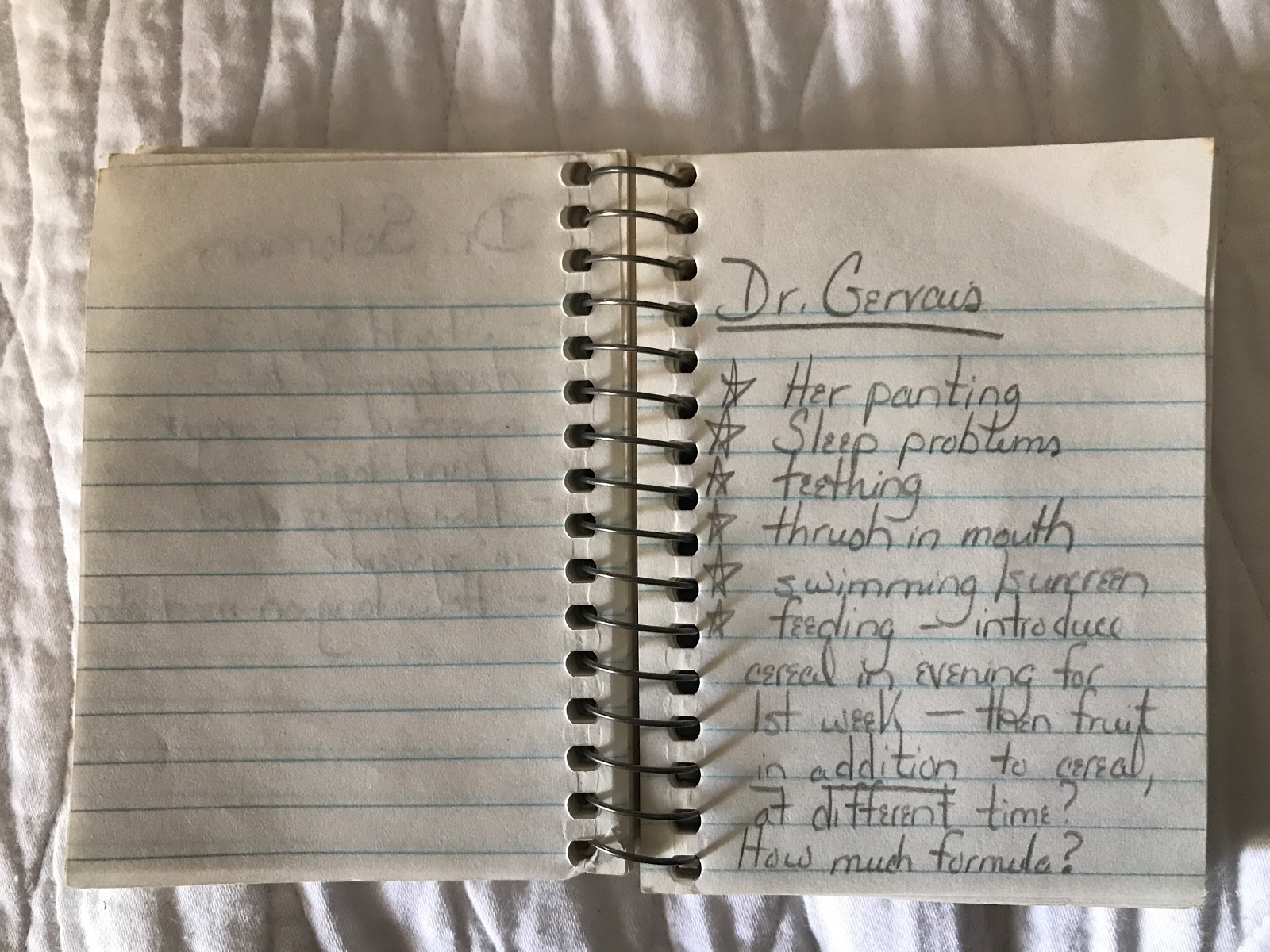
I found this in a shoebox of old letters at the back of my closet. I've always carried around a tiny notebook in which to jot observations, things seen that I might later write around. This one only had a few pages of scratchings -- the first dated March 25th, ironically, one day before Epilepsy Day (which I imagine wasn't a thing back then) and a few weeks after Sophie was born. It had that sort of innocence to it.
(branches).
The next page had this scrap:
I think I've told you before that I didn't write much of anything for many years after Sophie's diagnosis in June of 1995. An old writer friend of mine who developed Hodgkins disease in his early twenties once told me that he found it impossible to write anything during his treatment, yet I know countless people who've written quite brilliantly through whatever tribulations they've undergone. Write through it some people say, but I couldn't do that back then. I think it's because I'm good at punishing myself.
I can hardly remember what it felt like to be the me of those early pages of the little notebook. By the time the summer rolled in, we were in the thick of it.
There's no date on that list of questions I posed to Dr. Solomon, but she was Sophie's first neurologist, and prednisone was what we used when They (it's always They) ran out -- yes -- ran out of ACTH, the steroid gel we were injecting into Sophie. It must have been the middle of the summer of 1995, about two months after her diagnosis. As I remember it, ACTH was only used for six or so weeks because the side effects are brutal. Sophie's face blew up, and her eyes were slits, her mouth covered in thrush. It wasn't helping the seizures, either. The latter part of the treatment was a weaning period. That's when there was no ACTH to be had (what the hell, right?), so They (it's always They) put Sophie on prednisone. The weaning process gave Sophie pseudo tumor cerebrii, a rare side effect. I noticed Sophie's fontanel bulging one day, not just when she screamed, which she did most of the day while on ACTH and prednisone, but even when she passed out. They (it's always they) relieved the fluid pressure by giving her a series of spinal taps. Sophie was barely five months old. I turned 32 a month later.
I'm not sure how I got through those days, but I did, because here we are, right? Back then, I took notes in the little notebook and took it to her pediatrician.
Guess what? I haven't looked at this little notebook in more than twenty years, but I remember every single thing in my tiny little mother mind.™ It's as if my writer mind was compiling detail even as my writing was reduced to lists and questions.
Busy. Busy. Busy.
It's March 26th, 2018. It's officially Epilepsy Day or Purple Day.
I'm obligated to educate you about epilepsy. I got a message from a good friend whose young adult son has severe epilepsy. She is helping someone in the Epilepsy Community find a good neurologist for her child who, they believe, has infantile spasms, the same syndrome that Sophie was diagnosed with back in 1995. If I told you that the treatment for infantile spasms is much the same twenty-three years later with the exception of a couple of new drugs and the "advancement" of brain surgical technqiues, what would you think?
- Epilepsy affects more than 1% of the population.
- 1 in 26 persons will develop epilepsy at some point in their lifetime.
- More than 30% of persons diagnosed with epilepsy will struggle with seizure control.
- 1 in 1000 adults and 1 in 4500 children will die from SUDEP (Sudden Unexplained Death in Epilepsy Patients) a year. This is the leading cause of death in patients with uncontrolled epilepsy.
Labels:
ACTH,
early days,
epilepsy,
Epilepsy Day,
medications,
memory,
musings,
seizures,
Sophie,
writing
Monday, February 5, 2018
The United States Medical System, Part Three in an Infinite Series told partially through photos
A friend of mine in the epilepsy community contacted me this morning from Canada. She had just learned that the drug Frisium (same drug as Onfi, a benzodiazepine that I've written about millions of times over the years as it's a hideous pharmaceutical with little efficacy for controlling seizures but is intensely difficult, if not impossible, to wean) is being discontinued. She wondered if the same stuff was going down here in the Disunited States.
Here's the announcement that the Epilepsy Toronto organization published:
Medication Alert: Discontinuation of Frisium Tablets in Canada
"Lundbeck has decided to discontinue the manufacturing of Frisium (clobazam) Tablets in Canada. They expect the current inventory to be depleted by the end of 2018.
This decision was not triggered by a safety issue, but rather is based on the numerous alternatives available in Canada. The decision was not triggered by a safety issue, but rather is based on the numerous alternatives available in Canada. Lundbeck is communicating this change well in advance in order to give healthcare professionals, patients and families as much advance notice as possible so that Frisium patients have ample time to successfully shift to an acceptable alternative."
My friend told me that she tried to get to the bottom of this issue by speaking with the company and then the pharmacist. Lundbeck told her that they "don't normally talk to the general public" and that she should speak to her pharmacist. The pharmacist knew nothing and said, "You should just call your doctor and they will prescribe something else." That evoked a little -- ok, a lot -- of sarcasm, because anyone who knows anything about Onfi/Frisium/clobazam knows that it's nearly impossible to wean it once you've been on it for more than a few weeks, AND there actually are no substitutes except for, maybe, Klonopin, which has its own set of horrors. I felt some small comfort in knowing that even in Canada, big pharmaceutical companies and pharmacies are as obtuse and insensitive as they are here. Canadians just don't have to pay for the bullshit, I guess.
See the ticket price of a 24-day supply of the drug Onfi that I picked up for Sophie just the other day. It's written very, very small up there in the right-hand corner. Sophie's been taking this drug in all of its iterations (Frisium, Onfi, tablet Onfi and liquid Onfi, non-FDA approved and FDA-approved) for nearly ten years. The cost for us has ranged from $550 a month to $70 a month over the course of years, and I've drug-muled it from Canada (you can find those posts if you go to the search bar and put in drug mule), gotten it from pharmacies in Germany and England, been reimbursed by non-profit foundations that are underwritten by Lundbeck (what a racket) and just plain coughed it up (the money, that is). Today, I can only get a 24-day supply because of the tight regulation of opiods and benzos, and since we use the liquid form (more expensive) and the pharmacy can't open a bottle to give a partial amount, we are stuck paying the co-pay every 24 days instead of once a month. Less drug, more money paid by us. Less drug given, more money made by insurance company, pharmacy and pharmaceutical company, I guess.
We have, above all, always been a slave to this drug and the cockamamie system because of its potency and powerful addictive characteristics. The drug has absolutely never really controlled Sophie's seizures. She was given her first benzodiazepine Nitrazepam at THREE MONTHS OF AGE on what was termed compassionate protocol because it was not FDA-approved. She was also given Ativan, Tranxene and Klonopin, none of which helped her and all of which were a bitch to withdraw. My tiny little mother mind™ wants to sit here and dwell on the fact that all of these drugs were and continue to be prescribed and given to little babies without any real knowledge of their long-term effects, but what's the sense of dwelling on The Great Unknown?
| Exhibit A |
It enrages me in the way that those of us who do this thing are enraged. We function quite well at a slow simmer.
Anywho.*
After my friend contacted me, I put on my Pharmaceutical Sleuthing Hat (see above).
So it goes, as Vonnegut said so pithily.
I wonder what it would be like if Vonnegut were the Chipper Pharmaceutical Dude. My mind goes hither and thither, thither and hither. That would be Joyce.
* I use this word facetiously as I despise it. If you're a New Reader, know that. It belies the intensity of the situation described.
Wednesday, November 15, 2017
The United States Medical System, Part Two in a Series Through Photos
| The Price of Addiction (deductible finally met in November because of MRI, etc., catalogued in The United States Medical System, Part One in a Series Through Photos co-pay for drug over eight years has ranged from $0 to $780 according to the whims of the United States Capitalist Medical System where patients are consumers and the HHS Secretary is Big Pharma |
Monday, October 30, 2017
Magnetic Resonance Imaging
It looked like a flower a jewel a prism a kaleidoscope of pink and red and green a mustard yellow. So beautiful it brought tears to my eyes. This part here, The Neurologist said, should be like a bush and it's more like a fern. The language of plants. I stood behind him, peering over his shoulder. My daughter's brain a bloom on a screen, his finger (or was it a pen) brushing along its tendrils, a fern not a bush. Space, too. Too much space there and there. How do I write this or do I not write this? Of course I will write this, me with the words, the ease of them. Call a flower tree and a tree flower (so I thought, lying on my back in the green grass of childhood) and what if we were just God's dream (God, not god, back then) and this, that, was a sort of dream. Calling a brain bush and bush fern. Standing there looking over his shoulder, my daughter's brain a bloom on the screen. The word atrophy. The feathering of a fern where there should be bush. The word cerebellum. I felt sick to my stomach for a moment, standing there, the dots in front of my eyes. Or was it faint? I need to sit down, I said, stumbled around the wheelchair and sat on the couch. I closed my eyes when he spun around on his chair. He's a nice man, a smart man, an honest man. Interesting that it was the tears that flustered him, not the brain a bloom on a screen. That's the way they are. I closed my eyes, heard him rummaging and then leave the room. Back in, he handed me a stack of paper towels, the brown rough ones from the bathroom. I thought that was funny. I really did. I thought it was funny. I'll write it all down, I thought, and then out. I'll build some kind of tension here on the page to mimic that in the room in the brain a bloom on the screen. Atrophy of the cerebellum. We'll need to compare it to an earlier scan (that I'll have to find, to root out from the bowels of some other hospital). The language of medicine mixed up with the language of business the language of poetry. And I a master of all of it nodding my head words blooms from my mouth. On the written report: indicative of epilepsy treatment. I always knew it. The word treatment. Just to be clear: Sophie's recent magnetic resonance imaging showed a couple of troublesome spots, including atrophy of the cerebellum. This could account for her gradual decline in motor abilities (walking, coordinating movement, balance, swallowing). The cause is uncertain -- too many drugs? long-term use of benzodiazepines? underlying metabolic disorder? genetic mutation? -- as always.
How do I write what comes next? I still have some tricks up my sleeve, The Neurologist said, and I laughed. I really did. I thought it was funny. Should they use phrases like this? Me with the chalked hands and the pirouette toes up on the high wire for decades. You as spectator your breath held.
Bloom, brain.
Sunday, January 8, 2017
Lazarian Mermaid
| this photo was not staged |
You know how it goes. No matter how hard I try, I can't shake the southern Italian superstitious woman in me, so I'm going out on a limb, and stepping out to take a risk, plus throwing in all my cards, and working every cliche in the book to say that Sophie woke up this morning like some kind of Ripette Van Winkle. She was lying in bed exactly as pictured above, looking straight up at me and humming. I should preface this by saying that, up to this morning, she has been just this shy of catatonic. That's not hyperbole. I've been in when Sophie's not well, Mama's not well mode for a few weeks, a familiar condition, off and on, that I've experienced for Sophie's whole life despite all the cultural admonitions to not tie one's identity to one's children. I threw out most of that stuff along with the book What to Expect The First Year. That book literally went tumbling down the garbage chute from the fourth floor of the walk-up where we lived the first hellish year of Sophie's life. The admonition to not allow yourself to be subsumed by your child, along with put on your own oxygen mask before putting on your child's and attend to your marriage before your children are perhaps wise and fitting, but hell if I haven't failed at both over and over and over.
Any hoo.
I feel like a new woman this morning because Sophie actually woke up making her customary sounds (she's been primarily moaning or been silent for the last couple of weeks) and looked right at me when I went in to her this morning. She was also able to WALK into the kitchen and ate her breakfast easily. She did not have a big seizure or five big seizures. She was positively cheerful.
I'm going to shift the southern Italian peasant mentality of jinxes with an attention to Gratitude for the Present. This means that I am perfectly aware that this good morning could turn on a dime (another awesome cliche), Sophie could sink back into catatonia and I to the Overwhelmed With Grief and Anger But Still Putting On a Zen Face Woman. Right now, though, she's good and I'm good. The people of this shitshow do nothing better than living in the moment.
Reader, I imagine you are wondering why Sophie has had this turnaround? I have no real concrete idea, but I am going with the fact that she was OVER-MEDICATED. Here's the thing. Sophie came home from the hospital in late October on three times as much benzo as when she'd gone in. This was to "compensate" for the ripping off of the Vimpat that was giving her hives (although the docs said it wasn't, yet still ripped it off so go figure). Increasing the Onfi was something I agreed to because there are some interesting studies about the combination of Onfi and CBD. CBD can elevate Onfi levels and perhaps the increased Onfi is what helps to control the seizures? What I'm thinking is that Sophie's Onfi levels were periodically sky-high and causing the horrendous side effects she was experiencing (ataxia, difficulty swallowing, lethargy, CNS depression, excessive drooling, inability to walk). At the same time, since she's been on the drug for the last nine years, at one level or another, she is habituated to it and therefore sees very little seizure control. Basically, being on a benzo is a clusterfuck of enormous proportions. I was texting a fellow seizure mother this morning about it:
What a fucking shitshow and goddamn clusterfuck, is what I said. I'm not going to apologize for the foul language because it's entirely appropriate. I also told her that while I was going to work on weaning more of the benzo, I wouldn't wean myself from cursing about it.
In fact, I said, I'm titrating up on the cursing.
I'm going to have to figure out what the perfect sweet spot of benzo and CBD is, and that'll take some time. But hey! I have all the time in the world if I put that oxygen mask on first, right, and take care of myself (as this Australian article emphasizes).
Thursday, October 27, 2016
Taking Down the Patriarchy
| Ocean Park Beach photographer: Carl Jackson |
I've been reading Nobel Prize winning writer Svetlana Alexievich's Voices from Chernobyl: The Oral History of a Nuclear Disaster. Yeah, light reading. Just kidding. I'm reading it in Russian, too. Just kidding. Actually, I'm not into the light reading thing. Light reading makes me feel anxious and depressed, seems to exacerbate my feelings of there never being enough time to read all the books. I feel the same about movies. Reading "light" or watching crap makes me want to throw myself in front of a train. Getting through my days, sometimes, is only possible because of the art of others. Right now, speaking of trains, I'm listening to Anna Karenina in the car as I drive around the shitty. Dang, ya'll. That novel is relevant, and it's not about throwing oneself in front of trains. It's about love and bullshit, about peasants and patriarchy. There's even a passage about doctors and their uselessness that yours truly could have written!
Reading the extraordinary accounts of survivors in Alexievich's book doesn't just give me perspective but highlights just how resilient and dogged and strong, human beings can be, not to mention black-humored (the best humor, at least to me). The oral histories aren't for the faint of heart, though, as you can imagine. They're as much about vulnerability as they are about strength, and that's why, I think, they appeal to me. I have been feeling particularly vulnerable and fragile of late, for obvious reason. Not a day goes by that I don't have some sort of fantasy of fleeing in either body or mind or both, and whether it's because of the poisonous political atmosphere (don't pose false equivalencies to me: #Imwithher), or the thought of living in the same country with those who support or make excuses for you-know-who or struggling with caregiving and Sophie's epilepsy, acknowledging that vulnerability and fragility restores me. Really great literature -- whether it's fiction or non-fiction or poetry -- restores me. Not long ago, a relative accused me of having my head up my ass as far as my politics go. I think she was also pretty disdainful of the poetry that I put up here. I really don't think it's one or the other. For me, the personal is political and the political is personal and the only mitigation is art.
I got distracted. I was going to make this post about my optimistic feeling that despite all the acrimony in the country, I honestly think the patriarchy is coming down. It might be messy, and it might get even messier, but it's coming down.
Here's some "poetry" from Alexievich's book:
Bulgakov writes in A Cabal of Hypocrites: "I've sinned my whole life. I was an actor." This is a consciousness of the sinfulness of art, of the amoral nature of looking into another person's life. But maybe, like a small bit of disease, this could serve as inoculation against someone else's mistakes. Chernobyl is a theme worthy of Dostoyevsky, an attempt to justify mankind. Or maybe the moral is simpler than that: You should come into this world on your tiptoes, and stop at the entrance? Into this miraculous world...
Aleksandr Revalskiy, historian
Friday, October 14, 2016
Palimpsest
You didn't think I'd just let things go, did you? Just as they always have, and do, they percolate, lay down in layers on top of one another, waiting to be urged into shape. Did you know that Rome is a city of layers, that about fifteen feet down are the remains of Late Antique Rome (between 1500 and 800 years old) and then another fifteen feet below that is another? And so on. That dermatologist with the Drumpf hair wanted a CAT scan of the skull, threw out diseases and words, mused, casual, and then he dismissed the giant hives as coincidence and prescribed the antihistamine with the green label with a shrug. I nodded my head and asked intelligent questions, like I do, but he disappeared in a puff of dander in my mind. You didn't think I'd let it go, did you? I lay down on the bed for hours as the words lay down in layers, waiting to be urged into shape. I feel the urge. Otherwise I'd go mad, not be mad but go mad. Go.
I read a free article in Esquire today about an epileptic man, Henry, who was rendered an amnesiac in the 1950s, after an esteemed neurosurgeon basically fucked up the surgery. Stripped his memory with knife. I read this on my phone while sitting in the car at a Valvoline and a woman with dreads poked around in the car's netherparts. I'd call that a coincidence -- both the fact that of all the things on the internets that I'd click on to read was a story about an epileptic (named Henry) and that my car's netherparts were being explored -- but I'm not like the dermatologist or even the neurologist who prefers the empirical. I'm more inclined to believe that there are no accidents. Plus -- you know -- those layers. The author of the article was the grandson of the neurosurgeon. Henry's brain, though fucked up by the establishment, proved to be incredibly useful over the years, providing us with a wealth of information about the brain. Henry himself, the profound amnesiac, retained the memory of the surgeon who'd taken his memory, though, and whenever he'd get stubborn, let's say, about taking his medication, all They'd (it's always They) have to invoke was the doctor's name, his authority, and Henry would comply. Even after the surgeon was dead and Henry sat for hours doing crossword puzzles in a chair at the home where he'd lived ever since, the once upon a time.
I am as far from stripped of memory as Henry was stripped. Those layers.
Remember the layers. The latest ones laid over six days in the hospital. Lying for six hours the day after we returned home, waiting for words.
I am a reluctant ringleader in the circus, whipping my lariat around, one hand on my crop. There are the clowns in the car, spilling out, so many of them. A distraction. That beautiful woman on the rope above -- her balance and daring! -- is me as well, an alter-ego to be sure, her daring my dissociation. Even tigers are tamed in the ring, but they return to cages, crunch on bloody flesh. So it's all illusory -- the entertainment. Why always my urge to flee? Sophie, under my arm to some distant place. Something like the Chinese mountain scene I copied in watercolor for a high school art class. The drifting narrow clouds over peaks, the gentleness and peace of it. We're always digging holes to China.
Did you think I would rest here in some new-found wisdom borne of experience, that the razor isn't as sharp, my whip as precise? Some of us struggle and reconcile. I struggle and resist. Sophie's eyes and everything in them. We are unwitting Bodhisattvas.
pal·imp·sest
ˈpaləm(p)ˌsest/
noun
- a manuscript or piece of writing material on which the original writing has been effaced to make room for later writing but of which traces remain.
- something reused or altered but still bearing visible traces of its earlier form.
Saturday, October 8, 2016
You Cannot Fold a Flood
So, um, the hives came back.
My instincts are evidently still pretty sound. That big 'ole bolus of Vimpat was the wrong approach. The Sweet Doctor Whose Name Rhymes with Kevorkian confirmed them. He got on the phone with Doogie and our regular neuro and pulled the Vimpat. When I pulled back Sophie's hospital gown and saw the giant hives covering her, I felt terror (not at the hives but at the feeling they don't know what they're doing), a rush of anger (not at the doctors but at The SITUATION) and then just that same preternatural calm that I imagine has everything to do with Hospital Time and the weird stasis that comes along with sitting next to your child in a hospital bed for hours and hours. Then Sophie's father came in to spend the night with her and I drove the streets of the shitty back to my bed and fell into a deep sleep and dreams of boats and waves and whales. Honestly, I did.
So, what's the plan? The plan is to increase Onfi, the benzo, and work with the CBD. Someone asked me yesterday why I would continue to use the CBD when "it wasn't working." I'm not sure why Sophie fell out of the pretty decent seizure control she had for nearly three years. Maybe it was a virus, maybe it was the switch from brand to generic hormones, maybe it was a tilt in the earth's axis. As you can see (and what I've been writing and railing about for the past twenty years), the best doctors in the land don't know a lot either. Cannabis medicine is not a cure for seizures, but it's the only thing that has made a dramatic difference in her life. I really do think that we need to tinker with it and with the Onfi to get back to some kind of sanity. There are studies "out there" showing that the combination of Onfi and CBD helps to decrease seizures for some people. We're not fond of Onfi because it's basically a terrible drug that causes profound addiction and tolerance, but I think playing with it is in order.
I'll keep you posted. Thank you for buoying us the last few days. It means the world.
Here's a poem by the great Emily Dickinson that one of my friends sent me. Thank you, Anne.
You cannot put a Fire out—
A Thing that can ignite
Can go, itself, without a Fan—
Upon the slowest Night—
You cannot fold a Flood—
And put it in a Drawer—
Because the Winds would find it out—
And tell your Cedar Floor—
A Thing that can ignite
Can go, itself, without a Fan—
Upon the slowest Night—
You cannot fold a Flood—
And put it in a Drawer—
Because the Winds would find it out—
And tell your Cedar Floor—
Emily Dickinson
Friday, October 7, 2016
Doogie Howser, Sophie and The Tiny Little Mother Mind
| One very fucked up EEG |
Sophie is sleeping right now. As you can tell, I'm ok. Strangely calm which might perhaps be dissociative but could also just be -- well -- calm.
Friday, September 9, 2016
Smells Like Bullshit, Episode 45,678,982
Unless you've been living under a rock (and I've said it before, I understand), you've seen the various articles coming out at least once a day regarding radical price increases of popular pharmaceuticals. Most recently, there's the Epi-Pen story with its handsomely paid CEO, daughter of a Democratic congressman, and today's selection was about pharmaceuticals that treat inflammatory conditions, including arthritis. You can read about that right here and then come back to hear what the tiny little mother™ mind thinks about it all.
(this blank bit of screen has subliminal messaging because I'm a bit of a conspiracy theorist and tremendously biased)
Are you back? I was going to make this a Facebook post but then got carried away enough to realize that my blog was a perfect place to rant a bit, especially because I so rarely do that anymore. That was a joke. I'm thinking aloud here, typing so fast my fingers are a blur (I scored very very high on finger dexterity when I took a comprehensive test back in the last millennium a skill that comes in handy for a number of things that I won't elaborate upon here), but it will help me to get it out of my system so that I can go back to my day with a modicum of sanity. You know, finish the housework, navigate the systems of care for Sophie, coax Henry along the college application process and remain level-headed while shopping at Target for shorts with Oliver.
Anyhoo.
This is mainly what I want to say about the continued clusterf**k that is Big Fantastic Pharma and Big Grandiose Private Health Insuranceland or The Big Big Medical Industrial Government Complex (I sound a little like Drumpf now, don't I?) as far as it relates to Medical Marijuana World. When this rant's finished, I'm going to fix it ALL. It's going to be GREAT.
Along with the EpiPen and arthritis drugs, epilepsy drugs have long fluctuated wildly in price -- a single dose of ACTH, the steroid routinely given to those with infantile spasms cost $154 when we gave it to Sophie back in the late 1990s. I believe it's upward of $16, 000 now, and that's not because of inflation. That's because of the mumbo-jumbo Big Pharma puts out -- you know -- the high cost of research, rising costs, blah, blah, blah, etc. Diastat, or rectal valium, an emergency medication that is now in generic form, has cost me as much as $1200 A DOSE and as little as $7.50. Long-time readers of a moon worn as if it had been a shell might remember my Drug Mule series when I chronicled what happened to the price of clobazam and how I gamed the system. I'll refresh you:
1. Called Frisium, clobazam was not FDA-approved when we first started using it. I paid out of pocket for it for many years, purchasing from a London pharmacy through a NYC pharmacy. Cost: $150 for a month supply. So, manageable.
2. Approved by the FDA and renamed Onfi, it was not covered under my Insurance Company's formulary and was priced at $1800 for a one month supply, 1/2 of which I was subject to, so that's $900.
3. I was no longer able to get Frisium but located a pharmacy in Canada that sold clobazam (remember Onfi, Frisium and clobazam are all the same drug and close cousins to Klonopin, one of the most heavily prescribed drugs in the US of Opiate Addicts) for $60. It became illegal to ship the drug across the Border, so two friends of mine in the Movie Industry, on location, picked it up and ferried it back to me. This was legal -- well, sort of -- but not sustainable, and in lieu of flying up to Vancouver every three months (I contemplated doing this and making a little vacay out of it), I turned next to:
4. A non-profit organization on the east coast that helps people with certain conditions get drugs for free or at a reduced price. I should add here that the Magnanimous Manufacturer of Onfi offered to give me a coupon for 12 months that would have taken $50 off the $900 co-pay (similar to the Epi-Pen CEO's magnanimity in lieu of reducing her $5 trillion salary). The non-profit PAID FOR THE ENTIRE CO-PAY which was like manna from heaven. I just had to swallow the small amount of vomit in the back of my throat when I found out that the non-profit was largely underwritten by the Magnanimous Manufacturer of Onfi and GOT A HUGE TAX WRITE-OFF for their charity to folks like us.
Are you following this because those four points were really just illustrative and an aside. Here's what I want to say today, in reference to that New York Times article linked above:
Guess what else is a potent anti-inflammatory?
I'll give you a hint: The DEA recently confirmed its status as a Schedule 1 drug, along with heroin and cocaine, meaning it has no medicinal value and can't be studied except under the most draconian of regulations.
Are you following me?
I'm no conspiracy theorist, but I suspect Big Pharma is getting their ducks (or dicks) in a row as they scramble to research and develop their own cannabis concoctions. The fact that we can grow it ourselves and make our own medicine means no money for The Big Guns, so we must all be subject to the scare tactics of Big Government and Big Private Entities. Free enterprise, baby. Capitalism, baby. Let the Market Do Its Thing, baby.
Us? THC, baby.
P.S.
While we're smelling the bullshit, if you have arthritis and live in a state where you can get some, try cannabis. It's a potent anti-inflammatory. I am not a doctor, though, and have only a tiny little mother mind™so please consult yours and don't sue me.
Subscribe to:
Posts (Atom)