Showing posts with label World War II. Show all posts

Saturday, August 8, 2015

70 Years After the Bomb


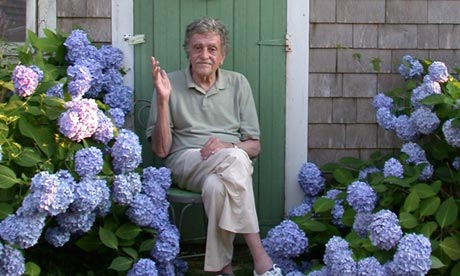
I first read Lawrence Ferlinghetti's poetry in college, after I went to hear him read it in an auditorium somewhere on the Chapel Hill campus, his own alma mater. I have also made several pilgramages to his City Lights bookstore in San Francisco, sat upstairs in the poetry room and run my hand over the many books of poets that were published there. I had forgotten about Ferlinghetti's service in World War II, though, and thought it a worthy thing to post his own thoughts as we all reflect on the great destruction wreaked by our country seventy years ago.

No matter what you think dropping atomic bombs on the Japanese civilian population did or didn't do for mankind, the lives lost and what was ushered in are worthy of reflection.

Here's one of his poems that I always loved from his collection A Coney Island of the Mind.


Constantly Risking Absurdity (#15)

Constantly risking absurdity
                                             and death
            whenever he performs
                                        above the heads
                                                            of his audience
   the poet like an acrobat
                                 climbs on rime
                                          to a high wire of his own making
and balancing on eyebeams
                                     above a sea of faces
             paces his way
                               to the other side of day
    performing entrechats
                               and sleight-of-foot tricks
and other high theatrics
                               and all without mistaking
                     any thing
                               for what it may not be

       For he's the super realist
                                     who must perforce perceive
                   taut truth
                                 before the taking of each stance or step
in his supposed advance
                                  toward that still higher perch
where Beauty stands and waits
                                     with gravity
                                                to start her death-defying leap

      And he
             a little charleychaplin man
                                           who may or may not catch
               her fair eternal form
                                     spreadeagled in the empty air
                  of existence

Monday, November 12, 2012

Veteran's Day and Vonnegut


I want to stand as close to the edge as I can without going over. Out on the edge you see all kinds of things you can't see from the center.
That's one of my favorite quotes of Kurt Vonnegut, whose birthday was yesterday, November 11th. He died in 2007 and thus never saw the inauguration of Obama, never mind the second, but he was notorious for his vocal hatred of all things related to war and particularly despised Bush for invading Iraq. I've read nearly everything Vonnegut wrote and like Cat's Cradle and Slaughterhouse 5 the best of all his books, but I love reading about him, too. A friend once told me that she passed him on the street in New York City when he was quite old, and she was struck by his big white-haired head and by the way he nodded it in greeting. This morning, I read a terrific interview with his daughter Nanette who has written the introduction to the newly released We Are What We Pretend to Be: The First and Last Works, which spans the beginning and end of Vonnegut's fifty-year career. Here's an excerpt, but you might want to read the whole thing on The Rumpus:

Rumpus: He never talked about his experiences in World War II with your mom?


Vonnegut: No. And he was a textbook PTSD sufferer. It’s only recently that veterans are encouraged to talk, let alone cry. My dad could be triggered by something like watching the news coverage of the Vietnam War. Both he and my mother were tuned in to what a load of crap it was. I remember him ripshit yelling at the TV saying, “Fucking lies!” I’ll never forget that. My mother was red-faced, saying, “They’re not going to take my boys. They’re not.”
My father was remembering what it was like and he knew: these are a batch of babies going off to war for nothing. There was a reviewer, William Deresiewicz, who writes for The Nation. He said Slaughterhouse-Five is not a book about flying saucers; it’s a book about post-traumatic stress disorder.
It's the day after Veteran's Day, and my kids are off from school. I'm going to do some laundry and other housekeeping things, perhaps knit a bit more of my sweater, take Sophie out and about in the sunshine and maybe delve, again, into Slaughterhouse 5. I'm going to feel grateful that I can do all of these things, freely, because of people like Vonnegut whose literal fighting as a soldier is only a small part of what he contributed to humanity.

Thursday, September 9, 2010

Beyond the 11th


I opened my mailbox this morning to a really wonderful op-ed by Nicholas Kristof of the New York Times. It opened with the following:


This weekend, a Jewish woman who lost her husband in the 9/11 attacks is planning to speak at a mosque in Boston. She will be trying to recruit members of the mosque to join her battle against poverty and illiteracy in Afghanistan.


Other memorable quotes in the article were:


Devastated themselves, they realized that there were more than half a million widows in Afghanistan — and then, with war, there would be even more. Ms. Retik and Ms. Quigley also saw that Afghan widows could be a stabilizing force in that country.


and


So at a time when the American government reacted to the horror of 9/11 mostly with missiles and bombs, detentions and waterboardings, Ms. Retik and Ms. Quigley turned to education and poverty-alleviation projects — in the very country that had incubated a plot that had pulverized their lives.


and


The organization they started, Beyond the 11th, has now assisted more than 1,000 Afghan widows in starting tiny businesses. It’s an effort both to help some of the world’s neediest people and to fight back at the distrust, hatred and unemployment that sustain the Taliban.


To me, these women and their actions constitute the most sane and humane way to deal with what happened on 9/11. While I do feel conflicted about the war in Afghanistan, I have to think that if we all contributed in the way these women have, against tragedy, without hate and violence -- we'd have less of it. I can sit here on this blog and offer my opinions -- opinions that anger some and that others agree with, I can talk and talk, here and on the phone, with my friends and elsewhere, but do I really contribute in any other way than talking and believing, nodding my head when I agree and shaking it when I don't? 


What is real engagement? In the world? In one's corner of the world?


I'm thinking about these things today.


You can read the rest of the Op-Ed  HERE.

Wednesday, September 1, 2010

Poem for the day, literally

I've said it before -- my favorite book in the Bible is Ecclesiastes -- and my favorite phrase might be "there's nothing new under the sun." It's sort of a guiding principle. I stumbled upon the following poem today by W. H. Auden, written on the eve of World War II.  It's long but one of the best --

September 1, 1939


I sit in one of the dives
On Fifty-second Street
Uncertain and afraid
As the clever hopes expire
Of a low dishonest decade:
Waves of anger and fear
Circulate over the bright
And darkened lands of the earth,
Obsessing our private lives;
The unmentionable odour of death
Offends the September night.

Accurate scholarship can
Unearth the whole offence
From Luther until now
That has driven a culture mad,
Find what occurred at Linz,
What huge imago made
A psychopathic god:
I and the public know
What all schoolchildren learn,
Those to whom evil is done
Do evil in return.

Exiled Thucydides knew
All that a speech can say
About Democracy,
And what dictators do,
The elderly rubbish they talk
To an apathetic grave;
Analysed all in his book,
The enlightenment driven away,
The habit-forming pain,
Mismanagement and grief:
We must suffer them all again.

Into this neutral air
Where blind skyscrapers use
Their full height to proclaim
The strength of Collective Man,
Each language pours its vain
Competitive excuse:
But who can live for long
In an euphoric dream;
Out of the mirror they stare,
Imperialism's face
And the international wrong.

Faces along the bar
Cling to their average day:
The lights must never go out,
The music must always play,
All the conventions conspire
To make this fort assume
The furniture of home;
Lest we should see where we are,
Lost in a haunted wood,
Children afraid of the night
Who have never been happy or good.

The windiest militant trash
Important Persons shout
Is not so crude as our wish:
What mad Nijinsky wrote
About Diaghilev
Is true of the normal heart;
For the error bred in the bone
Of each woman and each man
Craves what it cannot have,
Not universal love
But to be loved alone.

From the conservative dark
Into the ethical life
The dense commuters come,
Repeating their morning vow;
'I will be true to the wife,
I'll concentrate more on my work,'
And helpless governors wake
To resume their compulsory game:
Who can release them now,
Who can reach the dead,
Who can speak for the dumb?

All I have is a voice
To undo the folded lie,
The romantic lie in the brain
Of the sensual man-in-the-street
And the lie of Authority
Whose buildings grope the sky:
There is no such thing as the State
And no one exists alone;
Hunger allows no choice
To the citizen or the police;
We must love one another or die.

Defenseless under the night
Our world in stupor lies;
Yet, dotted everywhere,
Ironic points of light
Flash out wherever the Just
Exchange their messages:
May I, composed like them
Of Eros and of dust,
Beleaguered by the same
Negation and despair,
Show an affirming flame.

        --W.H. Auden

LinkWithin

Related Posts Plugin for WordPress, Blogger...