Showing posts with label photography. Show all posts

Saturday, July 25, 2020

Neowise


Yesterday, on an excursion to a place called Grassy Hollow where Carl and I headed for some much-needed nature, I read an article on the worldwide webs about the enormous hardship of our migrant workers, how they are bearing the brunt of the pandemic, even as they pick the food we eat, pluck the chickens we roast, slaughter and package the meat we barbecue. I won't regale you with the statistics, but it's gross. This country is foul.

How do we unhook from this culture?

This morning, I lay in bed thinking over-thinking wondering lamenting the usual morning fare. Professional basketball players are housed in what's being called the "Disney bubble," quarantined together with their families, at Disney hotels, kept safe and fed and tested constantly for the virus even as they are getting ready to finish the season of basketball that was so abruptly stopped and that fans so desperately await.

Do can will basketball players play without anyone watching? 

Does a tree make a sound when it falls if no one is there?


I'm reading an article in the newest New Yorker by Lawrence Wright titled "Crossroads." The subtitle is "A scholar of the plague thinks that pandemics wreak havoc -- and open minds." The scholar is Gianna Pomata, a retired professor at the Institute of the History of Medicine, at Johns Hopkins University who has returned to her hometown, the old city of Bologna, Italy. She compares Covid-19 to the bubonic plague of the 14th century -- "not in the number of dead people but in terms of shaking up the way people think." She says, "The Black Death really marks the end of the Middle Ages and the beginning of something else." We know that something else was the Renaissance. Pomata also says, "Chroniclers of the plague describe the crumbling of the family. At the same time, human beings are creative. They react to this perceived moral decay by creating new institutions." She's less optimistic about what's going on in our country, a country that she loves, where she lived in and worked for over thirty years. "What I see right now in the United States is that the pandemic has not led to new creative thinking but, on the contrary, has strengthened all the worst, most stereotypical, and irrational ways of thinking. I'm very sorry for the state of your country, which seems to be in the grip of a horrible attack of unreason. I'm sorry because I love it, and have received so much from it."


I just can't help thinking about the migrant workers picking my fruit and the basketball giants in their bubble. I can't stop thinking about those who are both ignoring the necessary actions we need to take and those who want to "get back to normal" or "learn to live with it." I am aware of the absurdity and privilege of my own lamentation.

Again, how do we unhook from this culture? Maybe you don't want to. Tell me why?


After wandering around Grassy Hollow, Carl and I drove to La CaƱada to try to see the comet in the northwestern sky. We parked on a street called Sleepy Hollow and walked up a dirt trail to a peak that looked out over the entire Los Angeles basin. We watched the sun go down in orange flame, a thin crescent moon rise, the lights of the downtown skyline appear out of a thin haze and then the Big Dipper. There, Carl said, just to the left of the ladle. I saw only a very faint smudge, my night blindness preventing any real recognition.  There was the comet, so aptly named Neowise, just barely visible to the naked eye, a cosmic snowball made of ice, rock and dust. I read that there are about 13 million Olympic swimming pools of water in Comet Neowise, that it's nearly 3 miles long and travels about 40 miles per second. When asked what she wanted to do when the pandemic was over, Gianna Pomata said that she longed to see her mother who lives in Sardinia. She wanted to swim there again. "Older people need exercise," she said. "I don't spend time at the beach gossiping with friends. I don't even take the sun. I just go immediately into the sea."

On Carl's super-camera, Neowise was a green blur with a fuzzy tail, 70 million miles away from the Earth where we stood.


I am grateful for my life. For life. I marvel and mark my own insignificance in this world. And I love the world and its people. But how do we unhook from this culture beyond going out into hollows and onto peaks to bask in and gaze at its mystery?


Here's a poem:

For the Sake of Strangers

No matter what the grief, its weight,
we are obliged to carry it.
We rise and gather momentum, the dull strength
that pushes us through crowds.
And then the young boy gives me directions
so avidly. A woman holds the glass door open,
waiting patiently for my empty body to pass through.
All day it continues, each kindness
reaching toward another—a stranger
singing to no one as I pass on the path, trees
offering their blossoms, a child
who lifts his almond eyes and smiles.
Somehow they always find me, seem even
to be waiting, determined to keep me
from myself, from the thing that calls to me
as it must have once called to them—
this temptation to step off the edge
and fall weightless, away from the world.

Dorianne Laux (1994)


Tuesday, December 19, 2017

This Is Still A Blog


For how could one express in words those emotions of the body?

Virginia Woolf, To the Lighthouse


I would like to be the Milky Way, star-stretched and caught by your eye, a lens made vigorous by my streak of starlight. Beheld. I would like to be that bird, hover point, my beak just above the water, the moment your eye blinks the shutter my shudder which is either from your shot, captured, or from the expectation of flight and freedom.


Sunday, November 12, 2017

Sunday Reverie


San Jacinto Wildlife Preserve
Lakeview, CA
photographer: Carl Jackson 

I’ll tell you how the Sun rose –
A Ribbon at a time –
The Steeples swam in Amethyst –
The news, like Squirrels, ran –
The Hills untied their Bonnets –
The Bobolinks – begun –
Then I said softly to myself –
‘That must have been the Sun!’
But how he set – I know not –
There seemed a purple stile
Which little Yellow boys and girls
Were climbing all the while –
Till when they reached the other side,
A Dominie in Gray –
Put gently up the evening Bars –
And led the flock away –


Emily Dickinson


Carl Jackson's photographs are available for purchase here.
You can purchase notecards and prints here.

Friday, September 15, 2017

"also, that you have enough"


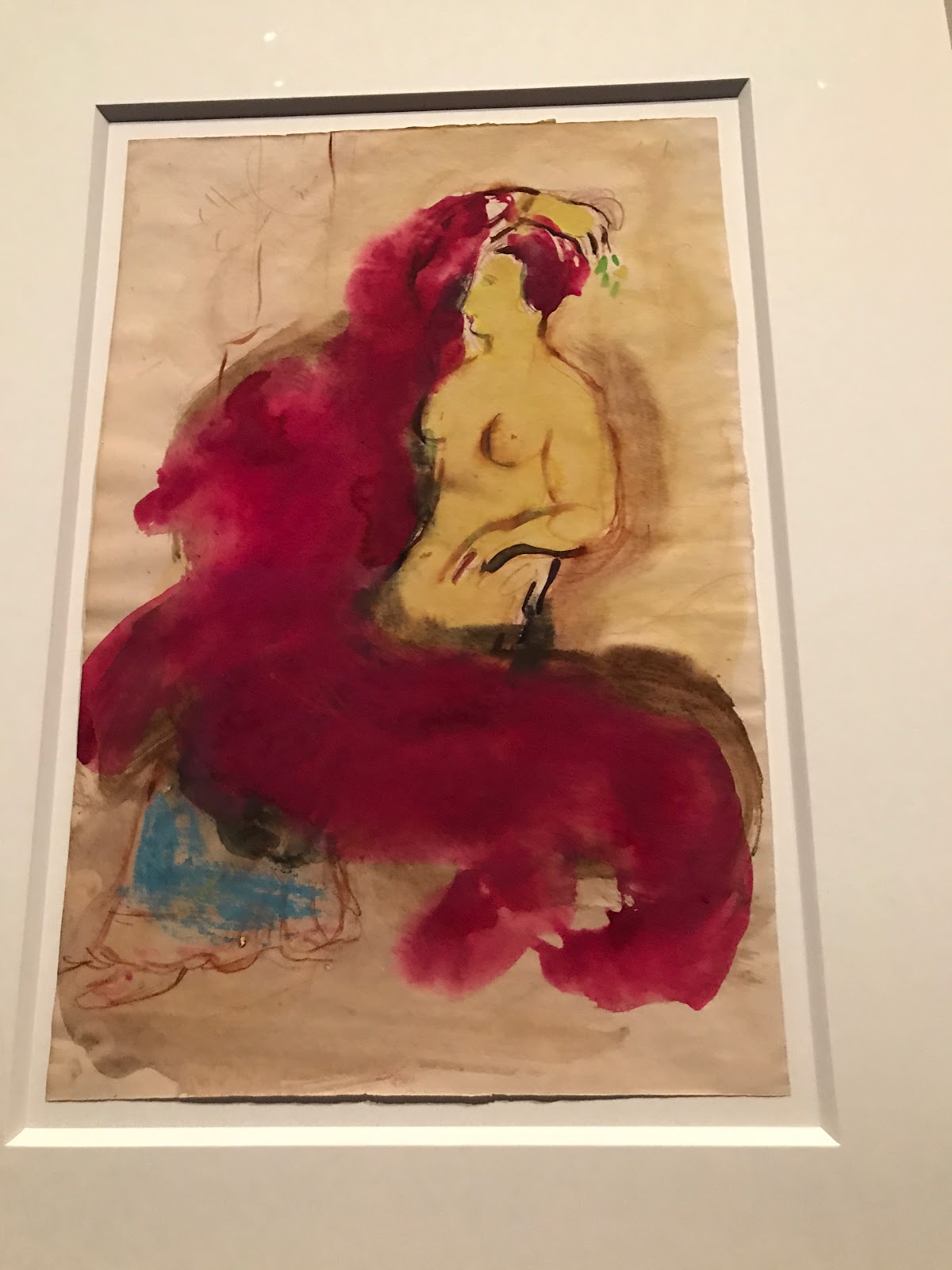
I went to an extraordinary exhibit at LACMA this afternoon with a few close friends.


Did you know that Chagall designed costumes for operas and ballets?


Honestly, this was one of the most extraordinary art exhibits I've ever seen -- just a few rooms of drawings, paintings and sketches and probably around twenty costumes, but each one practically gave me a case of Stendhal Syndrome. Do you know about Stendhal Syndrome? I saw someone fall down as if dead right by Michelangelo's David in the Accademia in Florence back in the last century. It's a thing, really. Look it up or click on the link I just gave you. Granted, I was feeling strung out when I decided to run over to the museum and join my friends. It's just everything lately -- and I'm doing weird stuff since I turned 54, like losing things and leaving my debit card at the post office. Like my mother always said, "I'm glad my head is connected to my neck, because otherwise it would have spun off." Chagall's joy and wonder in music and color and fabric and beauty and whimsy leaped out of every piece and just filled me with joy again.

And then there's the natural world. I'm reading an extraordinary book about landscape and words. The first chapter is called The Word-Hoard. Don't you love that? The book is called Landmarks by Robert MacFarlane. It, like Chagall's costumes and drawings, is joyous. Here are the first two sentences:

This is a book about the power of language - strong style, single words - to shape our sense of place. It is a field guide to literature I love, and it is a word-hoard of the astonishing lexis for landscape that exists in the comprision of islands, rivers, strands, fells, lochs, cities, towns, corries, hedgerows, fields and edgelands uneasily known as Britain and Ireland.

I don't know how many of ya'll out there are lovers of word-hoards, but get thee to this book if you are at all simpatico.


Check out that bamboo that lines the pathways to part of LACMA! That's natural!

Here's a close-up:


Is that not wild?

Why am I asking rhetorical questions?

The universe is abundant.

Here's a poem:


What You Missed That Day You Were Absent from Fourth Grade


Mrs. Nelson explained how to stand still and listen
to the wind, how to find meaning in pumping gas,

how peeling potatoes can be a form of prayer. She took
questions on how not to feel lost in the dark.

After lunch she distributed worksheets
that covered ways to remember your grandfather’s

voice. Then the class discussed falling asleep
without feeling you had forgotten to do something else—

something important—and how to believe
the house you wake in is your home. This prompted

Mrs. Nelson to draw a chalkboard diagram detailing
how to chant the Psalms during cigarette breaks,

and how not to squirm for sound when your own thoughts
are all you hear; also, that you have enough.

The English lesson was that I am
is a complete sentence.

And just before the afternoon bell, she made the math equation
look easy. The one that proves that hundreds of questions,

and feeling cold, and all those nights spent looking
for whatever it was you lost, and one person

add up to something.


Brad Aaron Modlin
(lifted from an OnBeing newsletter)


P.S. If I disappear from these parts, it's because I stole the dress that The Queen of the Night wore in The Magic Flute that's in that first photo. I'm going to get married in it and retire somewhere south of the Disunited States. Don't tell anyone.

Friday, August 11, 2017

"A good practical sort of immortality"


Just a couple of hours outside of Los Angeles, you pass through the most incredible landscape of farms and hills and endless road. It's where most of your produce is grown, folks, and last I heard, a lot of California farmland is filled with rotting produce because of that goon in office and his henchmen, busy Making America Great. They've cracked down on brown immigrants who work the fields, and the Real Americans are not stepping up to do the work. You can read about that here.


That isn't fake news either. But this isn't a post about the Pussy Grabber in Chief or his racist Attorney General Keebler Elf, so let's move on.

We stopped in the town of Earlimart to get gas and victuals.


The gas station had the best moniker I've ever seen yet was in direct sight of the Earlimart Market for World Peace.


Doesn't she make you want to pile the Bud into the trunk of your car and drive backward to when America was truly great?

Bless her heart.

Cast my memory back there Lord, sometimes I'm overcome --

Despite the Goon in Chief and his Band of Billionaires, you can pass through a lot of California now and see only a few "white" faces. This evidently terrifies a lot of people.

I find it thrilling that boundaries are blurry.


You can drive approximately five hours from Los Angeles, the sprawling home to over 8 million humans of every color, creed and culture and reach the south entrance of Yosemite National Park. My friend Cara, her two girls and my two boys have been numerous times together, and this year we stayed in a little cabin in the woods inside the park in an area called Wawona. We largely avoid the crowds in the valley and stay up and around the secret places near the park entrance.

We don't do much of anything, really, but wander around and look up and down, float on the river and lay on our backs on sun-warmed rocks. We laugh a lot, mostly at Oliver who can imitate anything and anyone. We all have riotous senses of humor. The girls balance the boys, while Cara and I eschew exercise and adopt the life patterns of marmots for the most part. Oliver did not let us forget our general "cringiness." If you need a translation, let me know.


We do this kind of thing:


and a little of this kind of thing:


and some of this kind of thing:


We even had a roadside "adventure" this year. Cara's car had an electrical short, we think, so we were mysteriously locked out of her car in the middle of Nowhere just after finishing up a roadside picnic. Our purses and phones were locked inside the car, and the teenagers, despite their phone appendages, were not connected to the world wide webs or the vast cell satellites arcing overhead, so we basically did one of those survival kind of things and put our privileged heads together to try to figure out WHAT TO DO.


I can tell you that everyone has an idea or opinion on how to break into a car.


You know what? We city slickers now marvel at just how hard it is to break into a car. Given how many of ours have been broken into in the big shitty, who knew that the windows are virtually indestructible, the locks un-pickable, the whole American metal machine invulnerable?

A few tourists did try to help, offering hangers and various tools. I have actually quite successfully broken into several of my cars, during days of yore, but my tried and true techniques just didn't hack it. I'm a woman of twentieth century crime, I guess. Other tourists just stared at us and took videos. Stupide americaines.  Our favorite samaritans were two women with blue hair and heavy Eastern Europeanish/Russian accents (think female versions, just barely, of what you might imagine our goon-in-chief's best Russian buddy sounds like)who walked over with crow bars from their rental and said, in what became a sort of anthem that Oliver repeated, over and over for the rest of the trip: Let me help you break open car.

Henry, who had otherwise made the women, men and children of Yosemite swoon everywhere we went, had no luck with a rock and muscle, and neither did the rest of us. I thought, in my optimistic way, that a solution would come to us, eventually, that we wouldn't perish with so much cheese and crackers and cans of limonata in the cooler and surely two marmots and a passel of teenagers wouldn't be attacked by any animal or human should it get dark.

Eventually, though, a couple of rangers pulled up on the scene, hammered a few wedges in the doors and saved us. To be fair, it did take them at least twenty minutes, and they were armed. We secretly hoped they'd shoot the car open, but that didn't happen.


We also did some more of this:


Oh yeah, and this:


I know. I know. It's almost ridiculous, except it's not. It is respite and wildness, air and water and earth and fire. I honestly think Yosemite is one, if not the holiest places on the planet, and my gratitude both for its proximity and my privilege to visit it, over and over, is boundless.


Another glorious Sierra day in which one seems to be dissolved and absorbed and sent pulsing onward we know not where. Life seems neither long nor short, and we take no more heed to save time or make haste than do the trees and stars. This is true freedom, a good practical sort of immortality. 
John Muir,  My First Summer in the Sierra, 1911

LinkWithin

Related Posts Plugin for WordPress, Blogger...