Showing posts with label medications. Show all posts

Monday, March 26, 2018

Archival Footage on Epilepsy Day


I found this in a shoebox of old letters at the back of my closet. I've always carried around a tiny notebook in which to jot observations, things seen that I might later write around. This one only had a few pages of scratchings -- the first dated March 25th, ironically, one day before Epilepsy Day (which I imagine wasn't a thing back then) and a few weeks after Sophie was born. It had that sort of innocence to it.


(branches).

The next page had this scrap:


I think I've told you before that I didn't write much of anything for many years after Sophie's diagnosis in June of 1995. An old writer friend of mine who developed Hodgkins disease in his early twenties once told me that he found it impossible to write anything during his treatment, yet I know countless people who've written quite brilliantly through whatever tribulations they've undergone. Write through it some people say, but I couldn't do that back then. I think it's because I'm good at punishing myself.

I can hardly remember what it felt like to be the me of those early pages of the little notebook. By the time the summer rolled in, we were in the thick of it.


There's no date on that list of questions I posed to Dr. Solomon, but she was Sophie's first neurologist, and prednisone was what we used when They (it's always They) ran out -- yes -- ran out of ACTH, the steroid gel we were injecting into Sophie. It must have been the middle of the summer of 1995, about two months after her diagnosis. As I remember it, ACTH was only used for six or so weeks because the side effects are brutal. Sophie's face blew up, and her eyes were slits, her mouth covered in thrush. It wasn't helping the seizures, either. The latter part of the treatment was a weaning period. That's when there was no ACTH to be had (what the hell, right?), so They (it's always They) put Sophie on prednisone. The weaning process gave Sophie pseudo tumor cerebrii, a rare side effect.  I noticed Sophie's fontanel bulging one day, not just when she screamed, which she did most of the day while on ACTH and prednisone, but even when she passed out. They (it's always they) relieved the fluid pressure by giving her a series of spinal taps. Sophie was barely five months old. I turned 32 a month later.


I'm not sure how I got through those days, but I did, because here we are, right? Back then, I took notes in the little notebook and took it to her pediatrician.
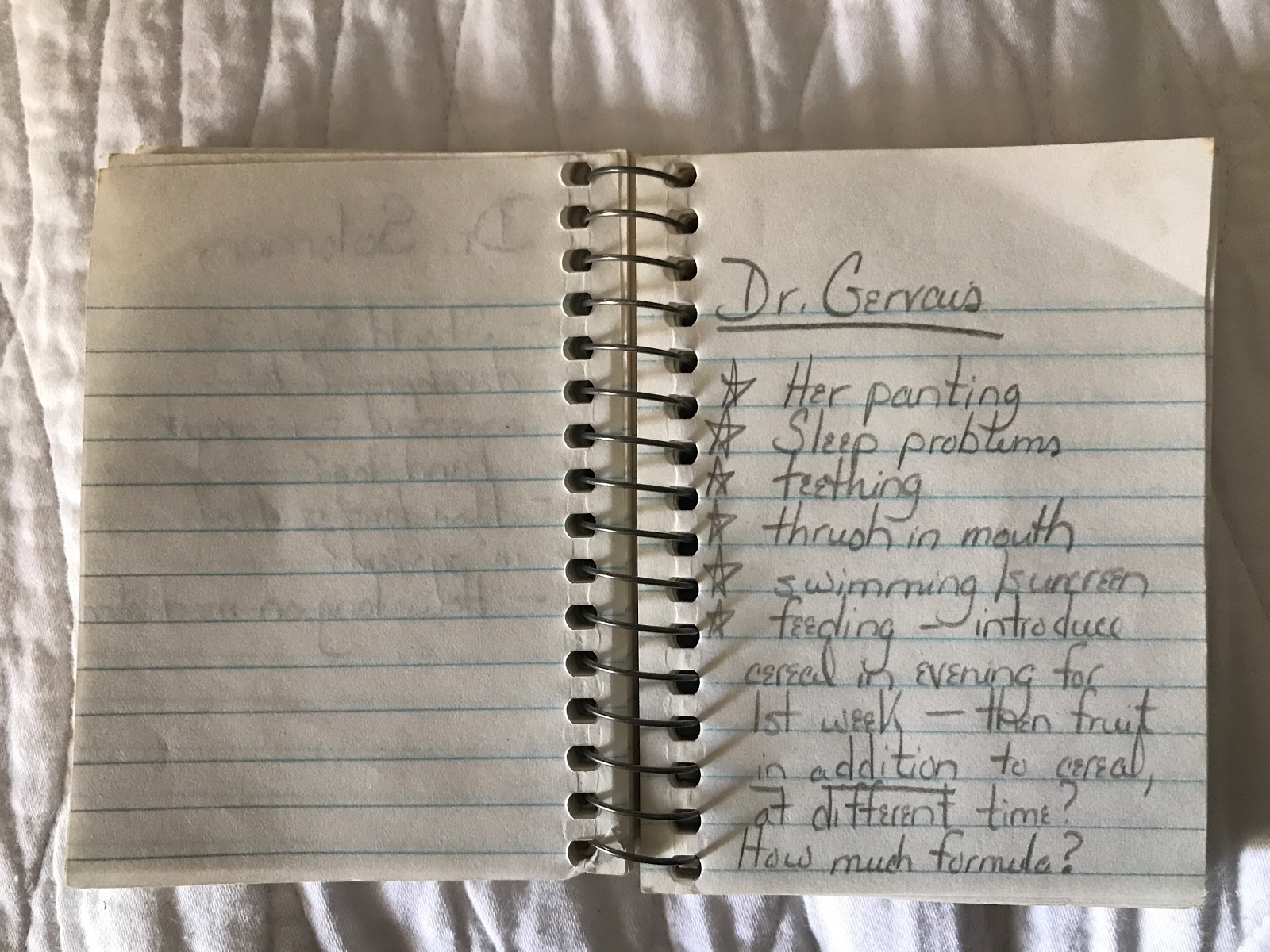


Guess what? I haven't looked at this little notebook in more than twenty years, but I remember every single thing in my tiny little mother mind.™ It's as if my writer mind was compiling detail even as my writing was reduced to lists and questions.


Busy. Busy. Busy.


It's March 26th, 2018. It's officially Epilepsy Day or Purple Day.

I'm obligated to educate you about epilepsy. I got a message from a good friend whose young adult son has severe epilepsy. She is helping someone in the Epilepsy Community find a good neurologist for her child who, they believe, has infantile spasms, the same syndrome that Sophie was diagnosed with back in 1995. If I told you that the treatment for infantile spasms is much the same twenty-three years later with the exception of a couple of new drugs and the "advancement" of brain surgical technqiues, what would you think?

  • Epilepsy affects more than 1% of the population. 
  • 1 in 26 persons will develop epilepsy at some point in their lifetime. 
  • More than 30% of persons diagnosed with epilepsy will struggle with seizure control. 
  • 1 in 1000 adults and 1 in 4500 children will die from SUDEP (Sudden Unexplained Death in Epilepsy Patients) a year. This is the leading cause of death in patients with uncontrolled epilepsy.


Wednesday, August 13, 2014

Cannabis Oil Questions Answered #3


How does Sophie take Charlotte's Web, and how much does it cost?

A lot of people don't realize that Charlotte's Web is a tincture with an olive-oil base and that it's easily drawn up in a small syringe and placed in the mouth. It tastes like olive oil with a faintly bitter tint, but I'm what you call a super-taster, so I imagine Sophie doesn't taste much of anything. The doctor recommends that it be given with either avocado or full-fat yogurt, but we don't always do this, either, as it's given three times a day, apart from Sophie's other medications. She gets it in the early morning, in the afternoon when she gets home from school and then around 10:00 at night. For the last dose, she's usually sleeping, but we're able to get it in her mouth without waking her up, and I've perfected the art, even, of getting her to swallow by rubbing her throat lightly or the sides of her face. I know that people give the medication through G-tubes, too.

As for cost, currently we pay $.05 per mg. I am averaging about $300 for a one-month supply. I know that's a lot of money, but to put it in perspective, I currently pay nearly $200 in co-pays for Sophie's medications, not counting the pharmacy deductible, and that's with private insurance and secondary Medi-Cal. Some of you long-time readers know that my co-pay for Onfi was nearly $500 a month until I got it from Canada for $61 and then found a non-profit foundation that picked up the co-pay. When we finally shed our abysmal Anthem Blue Cross policy and added Sophie to our Health Net plan (thank you, Affordable Care Act), we had to pay a slightly higher deductible, but they added Onfi to the formulary and picked up a greater portion of the Onfi cost (still hefty at $70). I pay $100 co-pay for the Vimpat. And we can't forget that those drugs do nothing for Sophie's seizure disorder, have horrible side effects and are a hellacious pain to wean.

I think I've said it before, but there's not much that I wouldn't do to come up with the money to pay for Charlotte's Web, given that it has cut Sophie's seizures down by more than 95%. You can go with that where you will.

Questions?


Other Cannabis Oil Questions Answered:

# One
# Two


Wednesday, April 25, 2012

Real vs. Bourgeois, Round One

Project Cyclone: Giant computers solve industry's toughest problems and open new, lucrative field for women interested in mathematics
Popular Mechanics, 1955

I'm going to introduce a new series here at a moon, worn as if it had been a shell, where I'll set my mind to parsing out some of the biggest problems in the world. I'm going to do a contrast/compare kind of thing and present a REAL PROBLEM and a BOURGEOIS PROBLEM.


ROUND ONE:


Bourgeois Problem:

This morning, I decided to take a shower and wash my hair for the first time since I got a few highlights put into it last week. I remembered that when your hair has been colored or highlighted, it is, in effect, fragile and perhaps even damaged, so I had bought a new bottle of shampoo to address this. The label specifically cited its efficacy in cleaning and deep-conditioning dry, damaged hair. I stood in the bathroom reading the label and wondered when, exactly, does one's hair turn from being sleek, shiny and healthy to rough, dry and damaged? Is this something I should have already addressed? Why did this happen? I hate that it happened.

Real Problem:

I got an email alert today from the Epilepsy Therapy Project, a wonderful site chock-full of everything you can imagine concerning epilepsy. Today's alert was titled Lamotrigine and Aseptic Meningitis and described the recent findings by the FDA of a strong correlation between the use of Lamictal (brand name of lamotrigine) and aseptic meningitis. Now, Sophie is no longer on Lamictal, although she took that drug for nearly seven years (aged three or so until aged ten!) and didn't develop aseptic meningitis that I know of. But Sophie is on some very new antiepileptic drugs that, I've explained here over and over, I never get used to administering to her. I describe it variously as like giving your child poison, year after year after year with no real expectation that it's giving anything but a modicum of seizure control. The Problem lies in this sentence, at the end of the article: 
This case highlights the importance that we need to continue systemic monitoring of antiepileptic drugs even after they are approved in order to fully understand the adverse effects related to any given medication.
You can read more about the Real Problem here. Is this something I should have already addressed? Why did this happen? I hate that it happened.

LinkWithin

Related Posts Plugin for WordPress, Blogger...