Showing posts with label early days. Show all posts

Monday, March 26, 2018

Archival Footage on Epilepsy Day


I found this in a shoebox of old letters at the back of my closet. I've always carried around a tiny notebook in which to jot observations, things seen that I might later write around. This one only had a few pages of scratchings -- the first dated March 25th, ironically, one day before Epilepsy Day (which I imagine wasn't a thing back then) and a few weeks after Sophie was born. It had that sort of innocence to it.


(branches).

The next page had this scrap:


I think I've told you before that I didn't write much of anything for many years after Sophie's diagnosis in June of 1995. An old writer friend of mine who developed Hodgkins disease in his early twenties once told me that he found it impossible to write anything during his treatment, yet I know countless people who've written quite brilliantly through whatever tribulations they've undergone. Write through it some people say, but I couldn't do that back then. I think it's because I'm good at punishing myself.

I can hardly remember what it felt like to be the me of those early pages of the little notebook. By the time the summer rolled in, we were in the thick of it.


There's no date on that list of questions I posed to Dr. Solomon, but she was Sophie's first neurologist, and prednisone was what we used when They (it's always They) ran out -- yes -- ran out of ACTH, the steroid gel we were injecting into Sophie. It must have been the middle of the summer of 1995, about two months after her diagnosis. As I remember it, ACTH was only used for six or so weeks because the side effects are brutal. Sophie's face blew up, and her eyes were slits, her mouth covered in thrush. It wasn't helping the seizures, either. The latter part of the treatment was a weaning period. That's when there was no ACTH to be had (what the hell, right?), so They (it's always They) put Sophie on prednisone. The weaning process gave Sophie pseudo tumor cerebrii, a rare side effect.  I noticed Sophie's fontanel bulging one day, not just when she screamed, which she did most of the day while on ACTH and prednisone, but even when she passed out. They (it's always they) relieved the fluid pressure by giving her a series of spinal taps. Sophie was barely five months old. I turned 32 a month later.


I'm not sure how I got through those days, but I did, because here we are, right? Back then, I took notes in the little notebook and took it to her pediatrician.
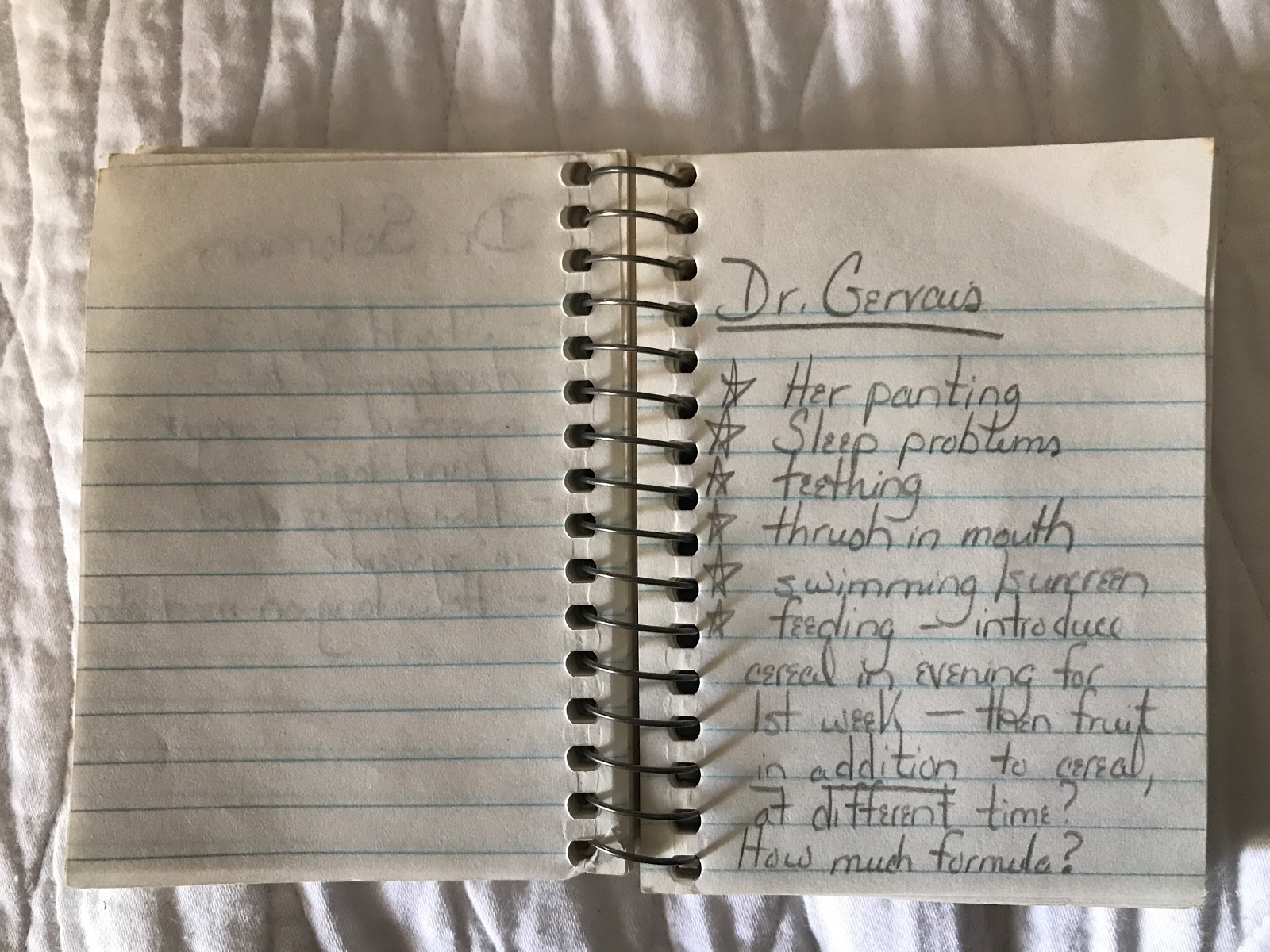


Guess what? I haven't looked at this little notebook in more than twenty years, but I remember every single thing in my tiny little mother mind.™ It's as if my writer mind was compiling detail even as my writing was reduced to lists and questions.


Busy. Busy. Busy.


It's March 26th, 2018. It's officially Epilepsy Day or Purple Day.

I'm obligated to educate you about epilepsy. I got a message from a good friend whose young adult son has severe epilepsy. She is helping someone in the Epilepsy Community find a good neurologist for her child who, they believe, has infantile spasms, the same syndrome that Sophie was diagnosed with back in 1995. If I told you that the treatment for infantile spasms is much the same twenty-three years later with the exception of a couple of new drugs and the "advancement" of brain surgical technqiues, what would you think?

  • Epilepsy affects more than 1% of the population. 
  • 1 in 26 persons will develop epilepsy at some point in their lifetime. 
  • More than 30% of persons diagnosed with epilepsy will struggle with seizure control. 
  • 1 in 1000 adults and 1 in 4500 children will die from SUDEP (Sudden Unexplained Death in Epilepsy Patients) a year. This is the leading cause of death in patients with uncontrolled epilepsy.


Wednesday, January 27, 2016

Dr. Viola Frymann, D.O. (1921-2016)

Dr. Frymann and Sophie, 1997


I learned today that the beloved osteopath who changed Sophie's and my family's life over twenty years ago died this week at the age of 95. All three of my children were patients of Dr. Frymann -- Sophie began treatments at ten months, when I'd fly to La Jolla for six week trips, living in a little motel by the sea. When I gave birth to both Henry and Oliver in Santa Monica, I traveled down to see Dr. Frymann when they were each less than ten days old so that she could give them a newborn treatment. She believed that treatment at birth and through infancy and childhood was of enormous benefit and freed the child from digestive issues, colic and the ailments that we've grown to expect and accept as we age (ear infections, "growing pains," back and neck pain, etc.). Over the next fifteen plus years, we made the trip down to San Diego multiple times a week and then month -- a drive that I never complained about because I knew what lay at the other end.

I credit her for setting Sophie on the path to true healing (something distinct from curing), and for ensuring the boys' vitality and ease (they were, quite simply, always jolly and rarely ill through childhood and neither ever on any antibiotic because of her treatments). I couldn't possibly describe this woman's impact on my own life and thinking. She is probably the only true healer that I will ever meet, the woman responsible for our move to California and for setting me on the path of integrative medicine and treatment. She guided me forward when I didn't know what to do. I believed Dr. Frymann when she told me about the body’s inherent ability to right itself, to heal itself, and that her work was to help the body find its optimal path. She never claimed to cure a person but to rather help that person reach his full potential. When she did speak of curing, it was in religious terms, an expression of her deep faith in Christianity and God’s power. Her work, though, was not religious, in the sense that she was a scientist who had studied and practiced osteopathic manipulation for over fifty years. If it weren't for Dr. Frymann, I have no doubt that Sophie would not be alive today nor she and her brothers in such good overall health.

She was your first ray of hope, my father emailed me this morning when I told him of her death.

Yes. She was my first ray of hope. She taught me nearly everything I know about healing and curing, about what it means to be human and whole. Her life not only affected ours but those of thousands of people around the world, and she worked and traveled and taught until her retirement at age 90, five years ago.

We will miss her and are grateful to have spent so much time, literally, under her powerful hands.

Here's an excerpt from a chapter in my book-in-progress about Dr. Frymann that gives you a small idea of her power and worth.


_________________________________________________________________________________
Dr. Frymann believed in the inherent dignity of each child, no matter how “damaged.” She never used the word “damaged” at all, in fact. Every child is worthy and has potential. Every child can understand what is going on around him or her, able to sense the environment and whether it is positive or negative. Her beliefs resonated with me and with those who made such an effort to bring their children to her. The simplicity of those beliefs tapped into our most fervent hopes but also affirmed the things we already knew about our children.

I sat in the “quiet room” at Dr. Frymann’s office while Sophie got her treatments during my first few visits to California at the La Jolla office, flipping through old Reader’s Digests and prayer books. Sometimes, I closed my eyes and leaned my head back on the old chintz-covered armchair, my hands loose in my lap. I knew that outside the sun was shining and that the palm trees were swaying from the ocean breezes off of La Jolla Cove. I heard the faint sounds of piano music coming from the music therapist in the treatment room and the gentle opening and closing of the front gate. When I opened my eyes, I saw that a woman had walked into the office with a girl in her arms. The girl appeared to be made horizontally the way she lay flat on top of the mother’s bent arms. Her feet, twisted inward, stick-straight out, level with her head, a long black sheath of hair hanging down over the other bent arm. She made no sound and there was no way to tell, really, what her age might have been. I tried not to stare, smiled awkwardly, instead, and said hello to the woman. She sat down, still holding the horizontal child, murmuring to her. The girl didn’t move in her arms, lay straight like a board.


When Dr. Frymann came out with Sophie, she handed her to me and told me that she’d see us in two days. When I asked how Sophie “did,” she replied, “Fine. Her vitality is much better.” She then turned to the other mother and lifted the girl into her own bent arms. The transfer was effortless, and now it was Dr. Frymann who carefully balanced this child over her arms, walking back toward the treatment room. “You are an Indian princess, yes, aren’t you,” she crooned to the girl as she walked away.

Monday, June 2, 2014

The Things I Carry


In a small zippered leather purse that looks like the old-time New York City coffee cups, I carry the following items everywhere I go:


  1. a cut-out photo of Sophie when she was recently diagnosed with infantile spasms and puffed up due to steroids
  2. a silk and silver pacifier clip that someone gave me when Sophie was born and is emblematic of that brief time before when sucking on a pacifier was enough to calm her crying
  3. a New York City subway token -- because I loved living there for the almost nine years I did so
  4. a dirtied, softened piece of paper with a note from my father that accompanied a check he sent to me for a treatment we wanted to try when Sophie was a baby. This is going to work, it said.
  5. Several angel charms
  6. A LOVE charm
  7. A Flow charm
  8. A MIRACLE stone
  9. A bug encased in a marble that I forgot to give one of my boys and decided to keep myself
Reader, what things do you carry?

Thursday, January 24, 2013

Rainy Day Music

This makes me think of a rainy night in Newport, Rhode Island, an old movie theater, running from there to here, faces wet, the way he kissed the drops, pushing away the cold of Canada, the older woman, our laughing through screens, my long legs.

Wednesday, April 11, 2012

I want to unfold

Sophie and I, 1995


I want to unfold
I don't want to stay folded
anywhere, because where I am folded,
there I am a lie.
And I want my grasp of things
true before you. I want to 
describe myself
like a painting that I
looked at closely for a
long time, like a saying that
I finally understood,
like the pitcher I use every day,
like the face of my mother,
like a ship
that took me safely through
the wildest storm of all.

Rainer Maria Rilke

LinkWithin

Related Posts Plugin for WordPress, Blogger...