Friday, October 18, 2013
Greg Pincus' Book About Pi and Pie
My friend Greg is a wonderful father, husband, a poet, a writer and a die-hard advocate for children with learning disabilities. He's also a published writer, and his new middle grade novel is called The 14 Fibs of Gregory K. Here's a trailer for the book:
Greg told me that there's a poetry angle to the book as well, and that Fibs in the title refers both to lies and to a 20 syllable, 6 line form of Fibonacci poetry that Greg got "sorta famous for" back in 2006 when he appeared in The New York Times! There are poems at the start of each chapter (save the last one), a few others in the text, too, and Gregory K.'s love of writing and poetry is what drives the whole plot. Geared toward kids aged 8-12, I'm here to tell you that even crones enjoy it. Greg himself is 97 years old!**
You can order the book HERE.
You can read Greg's blog HERE.
And, if you're really, really fortunate, you can hear Greg read from it and get a signed copy tomorrow, Saturday, October 19th at Flintridge Bookstore and Cafe from 3-5 pm. If you're not so lucky to live in southern California, you can listen to it live online, from 3-5 Pacific Time!
Just kidding. Greg is in the prime of his life.
On Being A, On Be Coming Crone
What I'm thinking about today is the onset of crone-dom and not in a jokey, silly sort of way, except that there are plenty of crones out there who will probably chuckle softly to themselves that I would deign to believe myself a crone at the tender age of fifty. I feel it approaching, though -- cronedom -- and I feel it as a lassitude and resignation, a comfortable giving-up and giving-in, a sardonic eye tilt and thinning lip, an exasperated descent into temporary insanity, a skill in holding ridiculous paradox, a desire to live and to be done with it, a quickening pulse, a pull between the legs, fullness drooping, a chopped off finger wag, abstraction made concrete.
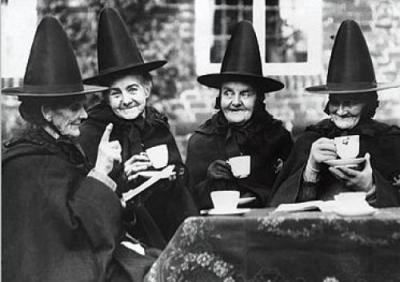
Crone talk over tea (from left to right):
Watching a child seize, day after day after day after day for years on end imposes a sort of discipline. You can actually live like that.
I dare you, to do what I've done and feel any other way.
Barn's burnt down,
Now I can see the moon.
Red lips, black hair -- they disappeared, but I taste them both, dearie.
Thursday, October 17, 2013
Brain Surgery, Part 2
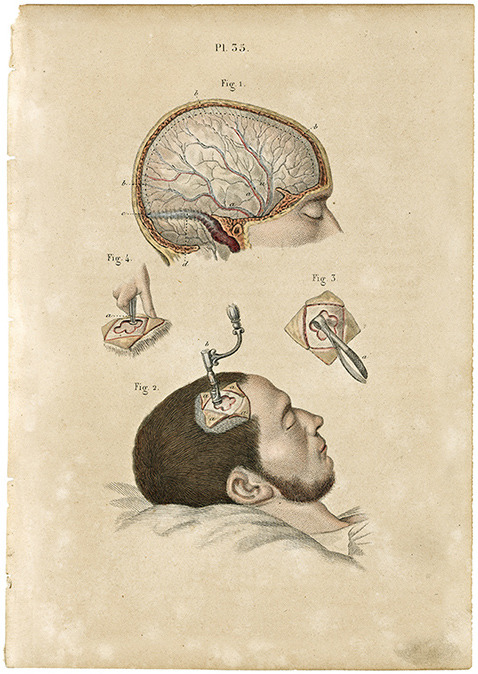
| Vintage Brain Surgery illustration, via Scientific American Magazine |
Here's Part 1.
And here's the rest:
“There have been great advancements
in the area over the last ten or so years,” he continued, “and outcomes can be
significantly more positive than they ever were.”
I
shifted in my seat, nodded my head, probably asked a question. I had done a lot
of reading but knew only a little about brain surgery.
“Basically,
there are two ways to go: a corpus collosum or complete hemispherectomy.” Dr. N
swiveled around in his chair and reached behind him for one of those replicas
of the human head, similar to the one my mother had in her closet when I was a
little girl. That one was made of Styrofoam, I think, and she used to put her
wig on it, when wigs were popular and even normal people wore them, like
jewelry or a belt. Dr. N’s head, though, was skin-colored and while it wasn’t
really lifelike, it was a lot creepier than my mother’s. At the top of the
head, a red line bisected the head and ran down the back, toward the neck. It
was this line that Dr. N traced, showing me.
It
was also about then that I started feeling really strange. I was asking
questions, I’m sure, intelligently, because I’m good at that. I’m not
particularly emotional with doctors and am able to keep my composure despite
the gravity of the situation. I felt all tingly, though, and was straining to
hear his words. It was almost like when the dentist placed the laughing gas
mask over your mouth before a procedure and his voice sounded like it was
coming from the far end of a tunnel. Dr. N, though, unaware of anything strange
going on, continued.
“You
see this line going down the center? That separates the right and left
hemispheres of the brain. Now, in a corpus collosum, you can basically snip
that line and actually break the connection between the two sides. If you do
that and it works, whatever side of the brain the seizure originates will stay
there, not travel and affect the whole brain.”
Snip,
snip, I think and right about then my head separates from my body and
floats on up over me, over the desk and Dr. N and hovers there, gently looking
downward.
“Now,
in a hemispherectomy, what you’re basically doing is cutting out the entire
right or left hemisphere of the brain and then filling up that cavity with
fluid.”
Since
my head is floating over my body, I actually see myself, nodding, murmuring,
leaning forward and watching Dr. N trace the red line down the brain, turning
it in his hands. I see my mouth move, talking to him, but I can’t hear what I’m
saying. I’m impressed, though, that I am talking at all about such a
thing. The difference between snipping the connections and removing the entire
hemisphere. Of my baby daughter’s brain.
I
don’t remember when my head or my consciousness rejoined the rest of my body. I
don’t remember how or when I walked out of the doctor’s office that day. I do
remember knowing that I had had a strange out-of-body experience that some
might call dissociation but to me was just part and parcel of the whole reality
of caring for Sophie. Is there any other way to respond when you’re discussing
brain surgery on a child?
People come up to
me periodically, whenever public television airs some special or they read about
the miracles of brain surgery.
“I
saw this program last night,” they’ll say, “and this kid had this weird
syndrome where she seized basically all the time. Well, they took out her
brain, I mean half of it and the other half just picked up where the removed
one left off, and now she’s great! Have you ever heard of that or thought about
it for Sophie?”
I
listen to this kind of enthusiasm politely, explaining that Sophie is actually
not a good candidate for brain surgery because her seizures are multi-focal,
meaning there isn’t one or even two spots where they originate. There are many.
But, actually, what I really want is to scream, “Are you fucking out of your
mind? Do you realize what you’re talking about? What they’re doing? Taking out
a chunk of a person’s BRAIN? A child’s brain, who can’t even make that decision
herself? How incredibly invasive that is? How utterly horrible?”
Yes,
yes, I realize that science can work miracles and that many people’s lives are
saved and the quality of their lives is vastly improved. But I can’t quite wrap
my own brain around the idea of cutting some of it out. Isn’t who we are
somehow encoded in our brain, in that organ? Would cutting it out inevitably
“change” that essential part of us?Right? Or not? Where I really get stuck,
though, is how to make that decision for another person. Because despite the
fact that Sophie is my daughter and, at the time, was an infant, and her father
and I have the responsibility to make decisions regarding her welfare, I
believe deeply in her personal integrity, her autonomy, the idea that she
exists, complete and whole. Who am I or who are these men and women who make
these decisions to cut out an essential part of who she is and discard it?
Arguments, I know, could be made that I am ignorant, that the brain is an
incredibly plastic organ, capable of regenerating, compensating and recovering
to an incredible degree. I think that if it were a question of life or death, I
would surely take the chance on life. Yes, yes, take it out, I’d say, if
that will save her. Anything to save her.
Thank
God I never had to make that decision, though, so I can nod my head when people
tell me about the miracles of brain surgery. I’m struck by how casually we all
live our lives, really, in these advanced times. We can sit in doctors’ offices
and intelligently debate the difference between cutting the corpus collosum and
the hemispherectomy. We can watch a two hour special on a network newsmagazine,
believing that those people’s lives are so amazing, can you imagine?
While sitting in the dentist’s chair, waiting to get a cleaning, we read an
article discussing the ethical decisions regarding a woman’s face transplant. I
feel like we were taken from the casual life eleven years ago when Sophie was
first diagnosed and dropped into this one of
constant impossible decision-making and a low grade anxiety broken only
by the adrenaline rush of true crisis.
And it’s no wonder, then, that my own brain was able to so effortlessly
release itself that morning – Snip Snip -- in the doctor’s office, let
go for a minute and watch, observe from a different position.
Brain Surgery
| Medieval Brain Surgery |
I imagine that got your attention on a Thursday morning, and I hope the presentation/performance that I'll be doing this afternoon in Tarzana will get some as well. I have the distinct privilege of reading an essay I wrote some years ago to a group of nurses and medical personnel with other mothers in a sort of mini Expressing Motherhood show. Brain Surgery is one of the chapters in my Book That Isn't Yet a Book, and it describes my experience discussing her possible candidacy for brain surgery when she was a baby and just diagnosed with epilepsy. Despite the near twenty years that have passed since that discussion, my feelings about brain surgery are much the same, and while I am, admittedly, distinctly irrational about cutting out a part of someone's brain, believing it to be something that we will perhaps one day look upon as barbaric (as we do lobotomies, let's say, or bloodletting), I understand that the techniques are becoming more and more sophisticated and outcomes more positive. That being said, I'm grateful not to have to make that decision for Sophie and can, instead, stay squirming in philosophical enquiry about it.
Here's the first part of the essay -- given its length, I'll post the rest later this afternoon.
I traveled across the country to Los Angeles
to see Dr. S , a pediatric neurologist known as “the best of the best,” and
when he examined Sophie she was still not a year old. He expressed his dismay
at the relatively poor outlook for infantile spasms, a rare form of epilepsy
that Sophie had recently been diagnosed with in New York City. He recommended that we have a pre-surgical
work-up. (Later, much later, when I had met many parents of children like
Sophie, we would joke about this doctor and call him “Dr. Knife”). He wrote in
his notes, which I still have in Sophie’s medical records file, that Sophie was
“a bright baby of just under one year.” I loved the “bright” part, pulled the
paper out often when I had gone back to New York. That one word sustained me,
sometimes, when I thought I would go wild with uncertainty.
But after that visit with the esteemed neurologist
of the west coast, when I put Sophie into her car seat in the white rental car
that I would drive to the airport to catch our flight back to New York, we were
on the road for less than ten minutes when she began to have what seemed like
hundreds of very small jerking seizures. I was driving on unfamiliar roads, on
the famous Los Angeles freeway, but I was driving with one eye looking in the
rear-view mirror, my lips counting, “one, two, three, four….it’s alright
Sophie, relax, twenty, come on Sophie, relax, fifty…” and so on until her tiny
arms which were methodically straightening, then stiffening, then bending
forward and her head bobbing and her mouth twitching, then grimacing, finally
stopped and she collapsed forward, her head hanging over the five-point harness
of the car seat. She had more seizures in that car ride than I had ever seen up
to that point. With no explanation, and there never was one, I attributed the
episode to her “bright” appraisal of the esteemed doctor and her listening in
as we talked about her condition, her prospects, her brain and the possibility
of surgery. In other words, she knew at
some level what was up and given the sensitivity of her brain, could only
respond to such stress with seizures.
Back in New York City I
made an appointment with our neurologist to discuss the recent visit to Los
Angeles. The day of the appointment, I didn’t have Sophie with me because of
the seriousness of the matters being discussed. I had made a resolution after
the incident in Los Angeles that I would try my hardest not to talk about her
condition in front of her. A “cutting edge epileptologist” who looked to be
about 35, Dr. N wore his blond hair with a distinct, vulnerable part down the
side, crisply pressed khaki pants, a white button-down shirt with a bow-tie and
shoes that I can only describe as Buster-Brown-like.
“Mrs. Aquino, please
come in,” the doctor stood at his door and beckoned to me. I was sitting in one
of those curved metal chairs with stainless legs and flipping through an old Scientific
American magazine. I put the magazine down and stood up abruptly, nervously
and walked down the hall to his office.
He had already seated
himself behind an enormous desk covered with papers, stacks of journals and
magazines and what appeared to be a child-sized replica of the human brain. The
cauliflower folds looked tough and protective of the smooth pink surface
beneath. The brain sat on a huge book, one of those diagnostic tomes that
doctors flip through in the privacy of their offices, when they can’t be seen
looking for information not easily recalled.
“Sit down,” he said,
motioning me to one of two armchairs angled toward one another and the imposing
desk in front of them. I was alone, though, as Michael was at work, and I awkwardly
pulled one chair out and then sat in the other.
“So, what can I do for
you today?” Dr. N. is an obviously intelligent man but sweet as well. He is
thoughtful instead of arrogant, appears earnest and concerned. His face
is placid, his eyes warm but they blink like a cartoon child’s. He is gracious,
almost humble, and he asks questions in a manner that gives you the sense that
you are making the decisions, not he. When I relayed to him the information
that I had recently received from the acclaimed Dr. S in Los Angeles, Dr. N
leaned forward and put his hands together, fingertip-to-fingertip, like a
little tent. He leaned his chin on the top of the finger tent, blinked several
times and listened intently. It seemed like what he heard was going into his head
and then down through his fingers into that tent on his desk. Neurologists have
so much power, you see, what with their delving into the human brain. After a
year of dealing with them, I was painfully aware of that power and sensitive to
inferences. I wanted to get in that tent.
Dr.
N is a good listener and rarely interrupts, so when I was finished, he let go
of the finger tent pose and let out a long, “Hmmmmmm.”
It
was my turn to lean forward, which I did, restraining myself from placing my
own hands on the desk in front of me. I willed them into my lap, to be still. I
clenched my knees.
“Well,
let’s talk a little bit about brain surgery,” Dr. N began.
Wednesday, October 16, 2013
Henry, Pedicures, Medical Marijuana Update Number 31,276,459 and the Full Moon
That's my beautiful boy, getting ready to jump down and pick up the screen that fell out of the window. He came home early from school today, and I can't even begin to tell you how E A S Y it is to hang out with him.
I did some hard-core cleaning today -- mainly in the boys' bedroom. They have an incredible amount of stuff -- let's be honest and call it shit -- piled in every nook and corner, so I got a big box and literally swept it off the shelves and into the box. I'm going to tell them to go through the box and only remove the things that they really, really value. Something tells me that most of it will appear, again, on the shelves or in the drawers or under the bed, but at least, now for one day, the room is pristine.
I also walked around the corner and got a pedicure. I splurged and did the hot stone treatment, and while my legs and feet were being massaged with hot black rocks, a woman called me and we talked for the rest of the time about medical marijuana, about CBD butter and tinctures and how it's helping her son and how everything, everything is moving toward it. We're going to meet next week, and she's going to let me try what she has been using for her eight year old son quite successfully.
The universe is abundant.
The Pediatric Cannabis Therapy of California Facebook group has a whole thread of comments about the upcoming full moon, Santa Ana winds and increased seizures in our kids.
The universe is strange.
I might be insane, but as I told a friend, I'm calmly insane.
The universe is constantly trickling through my fingers, and I can't hold onto it which is probably just right.
Literary Survey
I love a questionnaire and I love a survey. I also love books and reading and anything literary. So, in a break from our regular programming of politics, disability, parenting and poetry, I've taken Maggie May's lead and answered the following questions. I'd love to know what your answers are, so feel free to leave long comments or answer one or two!
Authors of whom you've read the most books:
Virginia Woolf, Toni Morrison and Fyodor Dostoyevsky
Best Sequel Ever:
I can't think of one. Do books have good sequels?
Currently Reading:
My Brilliant Friend by Elena Ferrante
Drink of Choice While Reading:
I don't drink while reading. Oh, maybe water sitting by my bed.
E-reader or Physical Book?
I love my Kindle for memoirs and "quick" reads. If it's an author I love or a book that I've anticipated, then a physical book is necessary. I'm finding that when I read fiction, I become more engrossed with a physical book and that the e-reader is distracting -- something about how fast I read and how weird it is to turn pages on the Kindle. The Kindle, though, has saved my budget AND enabled me to live in a house that isn't completely over-run by books or at least only partially so --
Fictional Character You Probably Would Have Actually Dated In High School:
Good lord, what kind of question is this? I think I had a crush on Dickon the rosy-cheeked moor boy in The Secret Garden. A bit later, though, and I would have gone for the main character in The English Patient -- what's his name, again?
Glad You Gave This Book A Chance:
I finally read a Don Delillo novel about a million years after I should have. It was Falling Man, and it blew me right out to sea. I had thought until I picked it up in the store that I would have to die never having read a DeLillo. It was a weird kind of blockage. I'm glad I broke through the intimidation and read his perfectly crafted sentences. Given how much I've read, I was also late to Updike, and when I read the Rabbit series in my forties, I felt incredible pleasure -- the writing, the vulgarity -- even the misanthropy -- appealed to me.
Hidden Gem Book:
Heaven's Coast by Mark Doty
Important Moment in your Reading Life:
Every moment of reading has been important, from the Big Red Book in Mrs. Semel's first grade class to the stack on my bedside table right this instant
Just Finished:
Remainder by Tom McCarthy -- sort of strange and creepy and interminable, really
Kinds of Books You Won’t Read:
Trash and popular fiction; anything by Dan Brown because he brings me
D
O
W'
N
D
O
W'
N
Longest Book You've Read:
The Way We Live Now by Anthony Trollope when I was pregnant with Sophie. God, it was good. I was depressed when I finished it, so I cheered myself up by clomping down the six flights of stairs in my walk-up apartment in my big brown and beige checked flannel maternity dress, to the Haagen Daz on the corner where I ordered a hot fudge sundae with whipped cream and nuts every single day before hauling my nine month plus two weeks extra pregnant self back up.
Major book hangover because of:
anything by Cormac McCarthy. Those books are dark. Oh, and I felt like I needed to take a shower after reading Gillian Flynn's trash novel Gone Girl. Generally, "easy" reads that are wildly popular give me hangovers because I'm so depressed that they're so successful. Go ahead. Confirm that I'm a snob.
Number of Bookcases You Own:
8
One Book You Have Read Multiple Times:
The Secret Garden by Frances Hodgson Burnett (just one, though? How about The Brothers Karamazov? Or Half Magic? To the Lighthouse and Mrs. Dalloway --
Preferred Place To Read:
In my bed.
Quote that inspires you/gives you all the feels from a book you’ve read:
So hope for a great sea-change/On the far side of revenge./Believe that a further shore/Is reachable from here./Believe in miracles/And cures and healing wells from The Cure at Troy by Seamus Heaney
Reading Regret:
That I tried to read War and Peace multiple times. I also regret all those horrible French books I read in college -- in French.
Series You Started And Need To Finish (all books are out in series):
I read the first Harry Potter and enjoyed it, but I admit to not really caring about reading the rest of them. Do I need to finish them?
Three of your All-Time Favorite Books:
To the Lighthouse by Virginia Woolf
The Brothers Karamazov by Dostoyevsky
The English Patient by Michael Ondaatje
Unapologetic Fangirl For:
David Sedaris
Very Excited For This Release More Than All The Others:
I'm always disappointed by new releases of contemporary authors I love the first time around, but I am looking forward to the new Jayne Ann Philips and to anything that Lorrie Moore decides to write --
Worst Bookish Habit:
I'd rather read than talk to you.
X Marks The Spot: Start at the top left of your shelf and pick the 27th book:
The Great Fires by Jack Gilbert
Your latest book purchase:
Quiet Dell: A Novel by Jayne Ann Phillips
ZZZ-snatcher book (last book that kept you up WAY late):
My Brilliant Friend by Elena Ferrante
Labels:
books,
bookworm,
literary snob,
reading,
surveys
Tuesday, October 15, 2013
Kerry Girl
This is Kerry, and barely a week ago, she died unexpectedly after surgery to correct a vicious infection. Kerry was three years old. Kerry's mother, Kristin, a woman whom I have never met, sent me the following email a few days ago, and I was quite suddenly yanked up and out of the abyss where I had been resting.
Hi there Elizabeth, I wanted to reach out to you for thanks. Our three year old daughter, Kerry, passed away almost a week ago. Her service was held just yesterday at our family's church. Your extreme parenting video was shown to the 200+ people that attended.
Kerry was diagnosed with infantile spasms shortly after her first birthday, and I so appreciated you and the rest of the bloggers I found that were able to put into words what I was and am are unable to express. During the service our pastor mentioned your "her eyes will sustain you" as a particular image that stood out to him.
i just wanted you to know that your video has reached so many people, and to thank you for putting into words what I have been feeling these past three years.
Thank you more than you will ever know,
KristinContrary to what some of you might think or even be feeling yourself, being yanked out of the abyss where I was resting was not, emphatically not, because I felt blessed, because my children were alive and not like little Kerry, gone far too soon. Kristin's astoundingly generous email to me and to you, the other parents that participated in the extreme parenting video, didn't separate me from her or my Sophie from her Kerry. I did not, for a moment, think Oh, thank God. Them, not me. Her, not her. Kristin's hand didn't reach into the abyss but was, I think, always there. I have been struggling to articulate this for days, this grace that descended in the form of an email from a stranger.
We are all connected. All the time.
Since that email, I have exchanged many words with Kristin and learned a bit about her beautiful little girl Kerry. Kerry and her twin brother Matt were born early in Colorado to parents who had long awaited children. It was clear that Kerry had some congenital abnormalities, and soon after birth she had her first seizure and was later diagnosed with infantile spasms. While the seizures were quickly controlled with medication, Kerry had developmental disabilities and made slow progress, but her family provided her with all the necessary treatments and of course, love. Kristin wrote this:
Therapies continued, head control was getting stronger, more avocados being eaten, plans being made for preschool and we got braver when taking her places in her toddler wheelchair. I did not handle the stares well, I must say. Many "chin down, eyebrows up" looks from me to people who looked a little too long. She also loved to sing...her songs were mostly drawn out vowels mixed with short consonants, but they were truly her. She supplied the soundtrack for our days. Scarves became her favorite texture, she would feel and stroke the fabric against her skin...finally found a use for my mothers satin pillowcases!
Kerry died after surgery to correct a massive infection in her ear, and Kristin told me that she hopes that her little girl is not forgotten. Please help me to help Kristin know that Kerry will not be forgotten, that this little girl who loved avocados and scarves, who sang to her family and provided the soundtrack to their days, is connected to each of us. Please let Kristin know that we are connected, all the time.
Thank you, Kristin, for sharing your little Kerry with me and for allowing me to share her with others. I am so sorry, so saddened by your loss, by our loss. We are all connected. All the time.
Monday, October 14, 2013
Medical Marijuana Update, Number 21,456,704
First of all, watch this:
This is where we are: at the end of the month, Josh Stanley of the group Realm of Caring is going to be here in Los Angeles, and a large news and information conference has been arranged. If you want details and are in California, seeking help for your child or for yourself, please email me at elsophieATgmailDOTcom.
Fingers crossed, toes crossed, prayers to the heavens and elsewhere.
P.S. Dear Mary, at Bless Our Hearts, wrote a wonderful post about this video and yours truly (Sophie, mainly!). Thank you, Ms. Moon!
This is where we are: at the end of the month, Josh Stanley of the group Realm of Caring is going to be here in Los Angeles, and a large news and information conference has been arranged. If you want details and are in California, seeking help for your child or for yourself, please email me at elsophieATgmailDOTcom.
Fingers crossed, toes crossed, prayers to the heavens and elsewhere.
P.S. Dear Mary, at Bless Our Hearts, wrote a wonderful post about this video and yours truly (Sophie, mainly!). Thank you, Ms. Moon!
Halloween Fixings and the Death of Twinkies
The only way Oliver and I could entice Henry away from the television yesterday afternoon was by appealing to his manly strength.
Only you can drive these stakes into the ground, Henry! we both said.
He obliged.
There was some good-natured banter between them that I was tempted to record as it's so rare these days. There was also the usual bickering.
I took a couple campy shots of Oliver, pretending to be dead in the graveyard. With a black and white filter, they were almost too creepy. The two of us went to Spirit, the grotesque all-things-Halloween store that pops up in our neighborhood once a year. We bought some more spider webs and walked around creeping each other out. There were horrible zombies and spiders that jumped out at you. There were nasty, nasty costumes and entirely inappropriate sexy Halloween costumes. The guy who was stocking the store was creepy, too, and I wondered whether they did background checks on the workers and then wondered why I would think that anyway unless it was true (a psychic hit?). There's so much shit in a Halloween store and so much shit makes me so weary in that bone weary way. Doom.
I sort of hate Halloween, but I cheerfully oblige my children's love of it.
So, Halloween is up chez House of Crazy. I've been for a walk already today and done a lot of housework and paperwork. An old friend sent me a grainy photo of a large group of girls -- a sorority photo -- from our days at UNC. She asked me who the girl to the right of her was, and the name came to me in one instant. I am finding this recall very weird today. Why is it that I can't remember the name of the book I'm reading but was able to look for one moment at this girl's face -- from nearly thirty years ago -- and know it? What the hell is that all about? These are the questions that creep out and try a woman's soul.
Sunday, October 13, 2013
Weekend Wrap Up: Henry, Oliver, Sophie, Oscar, Pigs in Chocolate and Me
That's my boy, getting ready for his first Homecoming Dance. Here's a shot of him getting his tie re-tied. There was a constant stream of comments from the Peanut Gallery. There were also looks of adoration from the Peanut Gallery.
Lest you think this was an idyllic scene, know that a fight ensued, and The Peanut Gallery's parting remarks were I hope you die at the dance! Henry's response was You're not a good person.
Brothers.
Looking sharp, Henry!
Well, the west coast has the sunshine and the girls all look so tan --
The only glitch in the night was Henry showing up at the gathering spot without a corsage for his date AND no jacket. I had suggested both and was nixed. Ahem. Thankfully, he did not die at the dance and, rather, danced the night away with about 900 other kids. I have to say that with the exception of the beautiful part, I'm glad that I'm no longer a teenager.
Earlier in the day, I had baked and decorated a chocolate cake for an adorable eighty-year old man. I had met this man a few months back, when I had dinner with him and his partner of forty years. They just got married, are both impossibly handsome and fun, and I'm just thrilled to have been included in the celebration. Here's the cake:
Here's a close-up:
And here:
Those are pink fondant pigs, basking in the best chocolate frosting you've ever made. It's Martha Stewart's recipe, and I think I posted it once on this blog, but I can't be bothered right now to find it. Kit Kats lined the cake.
Here I am at the party. I won an Oscar for the cake:
In all honesty, that's a real Oscar, won by my friend's grandfather back in the twenties. It is very heavy, very shiny and very cool.
Thank you to my readers, all of whom I would be desperate without.
Today, I'm doing laundry, setting out the Halloween shit with Oliver and otherwise relaxing. I increased Sophie's medication a few days ago, in a half-hearted attempt to decrease her seizures. The medication is a benzo and has a slow half-life (this is the sort of lingo that my peeps only will understand). It appears to be catching up with her, because this is what she looks like for much of the day:
The life of a person with uncontrolled epilepsy can truly suck, and I'm not going to mince words about that. One can certainly live well with epilepsy, but for the 30% of those whose seizures are not controlled or who need massive amounts of drugs to control them, epilepsy is a scourge -- god-d*&^ed, f*&%ing scourge.
So, not to leave you with a bunch of imprecations, but what are you up to this Sunday afternoon?
Saturday, October 12, 2013
A Resilient Anatomy
re·sil·ient
riˈzilyənt/
adjective1.
(of a substance or object) able to recoil or spring back into shape after bending, stretching, or being compressed.
synonyms: flexible, pliable, supple;
- I'm taking Oliver's lead -- springing back into shape, feeling my supple body, my pliable mind. There are no accidents, as my friend Carrie says, and hope springs eternal, says Alexander P.
Friday, October 11, 2013
Gravity and Nectar**
The burdens of the world
on my back
lighten the world
not a whit while
removing them greatly
decreases my specific
gravity
A.R. Ammons
Why We Must Struggle
If we have not struggled
as hard as we can
at our strongest
how will we sense
the shape of our losses
or know what sustains
us longest or name
what change costs us,
saying how strange
it is that one sector
of the self can step in
for another in trouble
how loss activates
a latent double, how
we can feed
as upon nectar
upon need?
Kay Ryan
**Thank you to A and to Noan for sending me these two poems.
Wednesday, October 9, 2013
I've Fallen and I Can't Get Up
| Yosemite, 2009 |
I appreciate all your kind comments, your emails, your words of support and, yes, empathy. My light posts of late mask a sort of paralysis I'm feeling elsewhere, and I'm afraid that I have to take a break from the pretense. I'll be sitting here a while, just sitting here, on the dock of the bay.
Naked
The reason you so often in literature have a naked woman
walk out of her house that way, usually older, in her front garden
or on the sidewalk, oblivious, is because of exactly how I feel right
now.
You tend to hear about how it felt to come upon such a mythical
beast,
the naked woman on the street, the naked man in the tree, and that
makes
sense because it is wonderful to take the naked woman by the
hand
And know that you will remember that moment for the rest of
your life
because of what it means, the desperation, the cataclysm of what
it takes
to leave your house naked or to take off your clothes in the tree.
It feels good to get the naked man to come down from there by a
series
of gentle commands and take him by the elbow or her by the hand
and
lead him to his home like you would care for a bird or a human
heart.
Still if you want instead, for once, to hear about how the person
came to be
standing there, naked, outside, you should talk to me right now,
quickly,
before I forget the details of this way that I feel. I feel like walking
out.
Jennifer Michael Hecht
Empathy***
It's already been a hell of a week, and I'm dragging. I feel sort of done. Done with all of it.
Do you want to know the only thing that's keeping me going?
There's this test you can take on the New York Times website. It's called Can You Read People's Emotions? Well, I do love a personality test -- can still remember how avidly I participated when they were published in Teen Magazine or Young Miss back in the dark ages. There's nothing like the self-satisfaction gained when you find out whether you're an INFP or an EJFX or whether your breasts can hide a pencil and are therefore sagging too early or perky enough that a pencil drops to the floor. I dropped a lot of pencils in my teen years, and when I stood with my legs together, there were three distinct triangles of space from my thighs to my ankles. Remember those markers, all you ancient comrades?
Anyway.
I took the reading people's emotions test and scored a whopping 35 out of 36 which evidently makes me some sort of mind reader, and all week I've been wondering how I can parlay this new-found skill into an occupation. Someone suggested the FBI, but my absurdist streak is too high for such an earnest position. Someone else suggested poker, but the last time I played cards I won sort of effortlessly because I'm lucky, and I pissed off the Card Powers That Be which kind of bewildered me. Today, I actually read an article about some study that found that those who read literary fiction were more empathetic than those who read popular or regular fiction. Examples for literary fiction were the obvious: Don Delillo, Chekhov, etc. Examples for popular or regular fiction were Danielle Steele and, not surprisingly to me, Gillian Flynn's Gone Girl (a book that I read and felt insanely jealous about, again, that such pablum was devoured by so many). See those glasses in that photo above? Well, I'm a literary snob, and I don't give a damn about claiming that.
Given that I scored near perfectly on the reading people's emotions test and am an unapologetic reader of literary fiction, my empathy skills know no bounds. Dump it on me, people. I can empathize.
Oh, and see those breasts up there? They're currently holding a Kindle Fire under them, so don't be imagining that my head is getting too big.
***First person to guess my emotions when I took that selfie up there gets a cupcake.
.
Subscribe to:
Posts (Atom)