Showing posts with label Tonglen. Show all posts

Friday, April 17, 2020

Bodhisattva


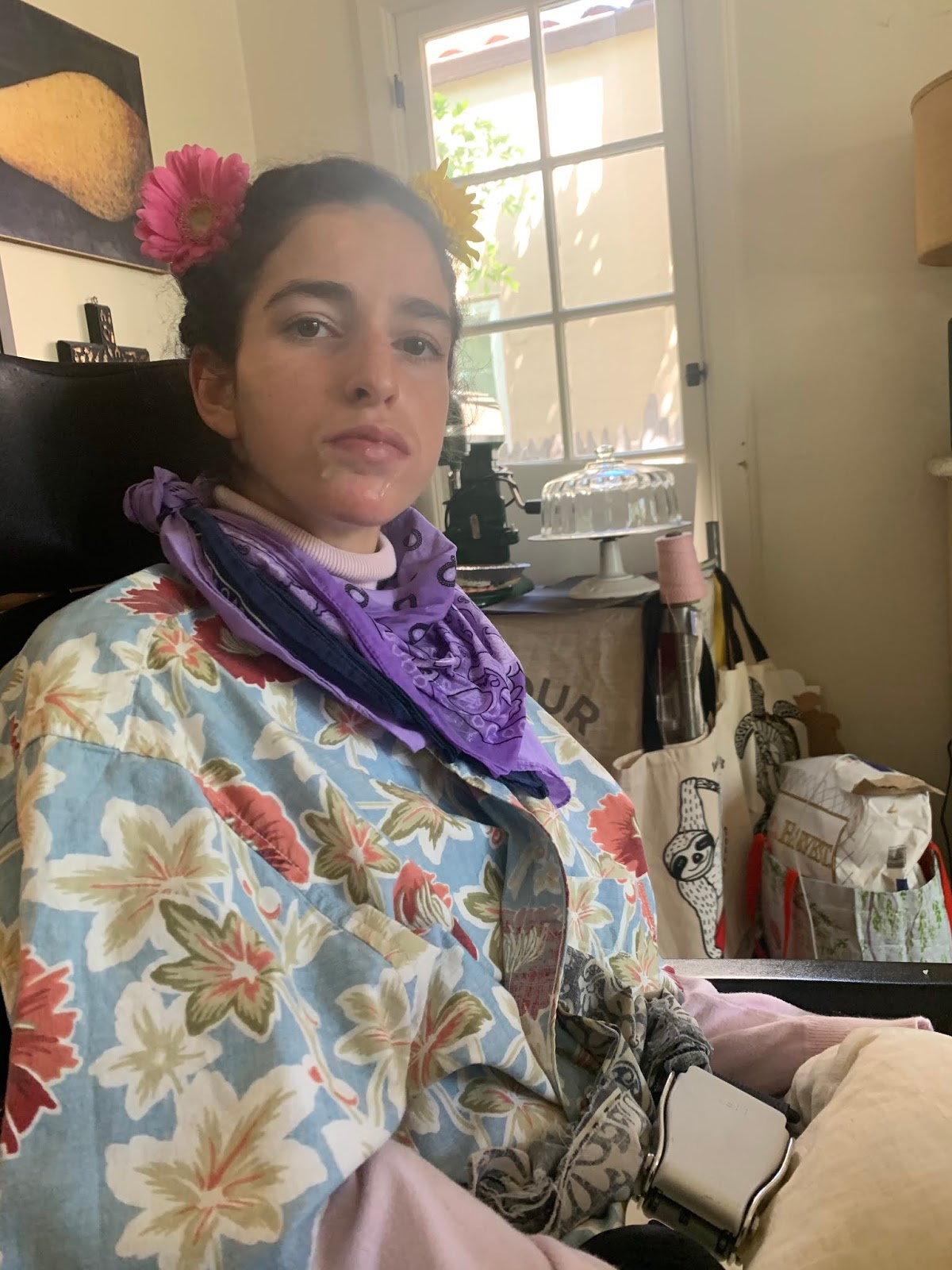
I'm all over the place. Perhaps. (condition) Filled with vitriol and judgement and sadness masked by bitter humor. I know this in parts (not part). It must be irritating to listen to someone compare a disabled person and her caregiver to a pandemic's dictates. To constantly draw parallels. Parallels. One line tilts at some point must tilt at some point in this madness we call living. Sophie knows everything about isolation and confinement. Her journey is not mine nor are there parallels. But tilt. Because she is my heart I can understand how deep. Fathoms. Unfathomable. Unfathom is not a word, but I am learning unlearning to do it because of her. When she was a baby and screamed for hours I rocked her in a brown and cream-checked chair from the life before her, chanting Breathing in I calm myself, breathing out I smile.  Tonglen. Breathe in all the world's pain and suffering and breathe out good. When I forget -- tilt and the unfathomable depth of her eyes.


Wednesday, December 14, 2016

Tonglen


Because there's this country, richer beyond any yet bankrupt in all the ways that count --

Because there's Syria --

Because it's the anniversary of Sandy Hook --

Because our planet is being plundered --

Because my own heart is bitter --


Tonglen:

Breathing in the suffering of the world and others, breathing out love and compassion. Taking on the world's suffering seems ridiculous, except that it's not.

I am tempted to take care of my own, to tend my own garden, to go within as without seems dark. The hammering next door, the squirrels' chatter over a tangerine, the way the sun slanted through the window this morning.

The sense of the country going to pot. Our country, the wretched led by the morally bankrupt. The impossibility for me of not looking out, not being engaged and informed. The impossibility for me of only looking within. Illusion.

My reliance on meditation, specifically tonglen, forgotten and remembered. Relief.

Acknowledging misery -- the world's and my own -- is just that. Acknowledgement. There is peace in acknowledgement. Breathing out love and compassion.

Love is a verb.


Thursday, June 16, 2016

Love is a Verb

Blue Grosbeak, Malibu Creek Post


Love is a verb – it wants to be active. It wants to be witnessed, felt, demonstrated, shared, flung and sung from treetops and from the bottom of our toes. Love does not want to be subordinate to grief and hurt – it wants to be part of it, it wants to be known as the cause of it. Love is longing to be woven into the entire emotional fabric of our lives – winding and revealing itself alongside every thread that is not love. This big, messy, beautiful tapestry is the truth.
Kristi Nelson, from Heroic Hearts: Love in the Face of Despair 


I imagine we're all sort of still shattered by what happened in Orlando and what's happening -- well -- everywhere in this country. I'm in more of a daze than I generally live in, and while I've work to do, children to attend and a myriad of insignificant problems, I feel weighed down and not sure of how to go about lightening up. My usual sense of humor feels dampened. I'm restless and distracted. I'm not often like this, in fact am rarely so, but I'm thinking some kind of extended meditation is in order. Going in and breathing out. Tonglen meditation is a Buddhist practice roughly translated as "giving and receiving." It's about breathing in suffering and breathing out compassion. When Sophie was a little baby and suffering from the side effects of the drugs we were giving her, she'd scream nearly constantly. Some days I'd put her in the middle of the big bed and get into the shower, turn on the water, crouch down on the floor and let the water beat on my back, the sound of it drowning out her screams. Then I read a little book by Thich Nhat Hanh whose title I can't recall in this moment, and I learned a mantra that I repeated to myself, over and over, as I held Sophie while she screamed. I didn't need the shower, nor to take a break. Breathing in I calm myself, breathing out I smile. Breathing in I calm myself, breathing out I smile. I didn't know it then, but that mantra and those breaths were a sort of Tonglen meditation, and they have saved me over the years, over and over again. But this isn't about me. It's about all of us. It's about breathing in to calm ourselves and then breathing out love to others. Maybe that's all we can do right now. Breathe in calm, breathe out compassion. Love out loud.


Wednesday, May 11, 2011

Street Tonglen

Alley near Melrose and LaBrea, Los Angeles 2011

I saw this painted on a wall in an alley right next to some gang tagging and thought immediately of Tonglen (I posted about Tonglen here).

Monday, May 9, 2011

Tonglen

Mother's Day, Pico Blvd., Los Angeles 2011


Breathe in for all of us and breathe out for all of us.

I had tea yesterday with a dear friend who shares many of the same problems that I have -- balancing a life of one's own with a family, a husband, financial difficulties, a child with special needs and the siblings of that child. We also share a similar sense of humor. We joked about the circus aspect of our lives, about our roles as ringmasters, about how impossible it all is and seems and how relentless. We even joked about gassing ourselves, pantomiming the method. At one point in our conversation, she looked at me and asked Do you ever wonder why it's so hard for us? I know she meant why our lives are so much harder than many of those we know -- many of our friends and most of our families -- and I don't have an answer other than a deep, abiding knowing that life is hard. It's hard, anyway. 


Breathe in for all of us and breathe out for all of us.


Those words are the great Pema Chodron's, a Buddhist teacher whose essay about Tonglen, the Tibetan word for giving and taking, a meditation practice, sustains me when I'm feeling down or overwhelmed, when life's suffering threatens to muffle its joy. 


Tonglen is a practice where one works with our tendency to avoid suffering and resist pain, a habit that also causes us to armor ourselves, separate ourselves from both interior experiences and those of others. It is a practice of compassion where you use your own suffering to alleviate the sufferings of others. Instead of resisting your feelings of anger, fear, despair, grief, pain, etc., you acknowledge them with your breath -- you even embrace them with your breath. And then you breathe out. When you breathe in again, you might acknowledge all the suffering of all the people you know and embrace that, too. And then you breathe out. When I am near to despair over Sophie's seizures I practice tonglen by breathing in the sufferings of all the mothers I know who have children that seize and all the mothers I don't know who have children that seize. And then I breathe out. I breathe out love and compassion and health and happiness for all those mothers and all those children.

I believe that embracing suffering, meeting it, accepting it and even embracing it might lead to understanding it, and that understanding connects me, deeply, to others.

Tonglen reverses the usual logic of avoiding suffering and seeking pleasure and, in the process, we become liberated from a very ancient prison of selfishness. We begin to feel love both for ourselves and others and also we begin to take care of ourselves and others. It awakens our compassion and it also introduces us to a far larger view of reality. It introduces us to the unlimited spaciousness that Buddhists call shunyata. By doing the practice, we begin to connect with the open dimension of our being. At first we experience this as things not being such a big deal or so solid as they seemed before. 
--Pema Chodron


LinkWithin

Related Posts Plugin for WordPress, Blogger...